No products in the cart.
Return To Shop.png?sharp=1)



Fix Cabinet Door Rubbing — One-Screwdriver Guide
Cabinet doors may gradually shift, rub against each other, fail to close smoothly, or even become misaligned after a period of use. Fortunately, most of these problems are not caused by installation errors or product defects, but simply by hinge position changes over time. The good news is that many cabinet door rubbing and alignment issues can be fixed with just a single screwdriver, by making a few simple adjustments to the spring (concealed) hinge.
Table of Contents

What Is a Spring / Concealed Hinge
Whether it is a wardrobe, shoe cabinet, bookcase, kitchen cabinet, or bathroom vanity, almost all household swing door cabinets rely on the same type of hardware to connect the door to the cabinet body. This hardware is often casually called an airplane hinge, but it is also known by more professional names such as hinge, concealed hinge, or spring hinge. There is no need to dwell on what it should be called. What truly matters is that it directly affects how smoothly a cabinet door opens and closes.
Why Cabinet Doors Go Out of Alignment Over Time
One of the biggest advantages of this type of hinge is that it can still be adjusted after installation. This makes cabinet door installation much easier. What once required very precise measurements can now be handled more flexibly. As long as the hinge is roughly fixed in place, most problems with opening and closing can later be solved by adjusting the screws on the hinge.

Each hinge comes with adjustment screws. One screw mainly serves a fixing function and can also be used for larger range adjustments. For clarity, we can call it the fixing screw. The other screw, located closer to the cabinet door, is only used for adjustment. This adjustment screw is designed for small movements and fine tuning.
After a cabinet door is first installed, hinge adjustment is usually necessary. Over time, frequent opening and closing may cause the fixing screws to loosen, which leads to doors that no longer open or close smoothly. Many people notice that their cabinet doors feel looser the longer they are used. In most cases, this happens because the fixing screws have loosened.
Basic Adjustment Principle
The basic adjustment principle is straightforward. When the fixing screw is turned counterclockwise to loosen it, you can gently push the cabinet door after opening it to adjust the distance between the door and the cabinet body. After each adjustment of the fixing screw, the adjustment screw should also be fine tuned again.
The adjustment screw controls the distance between the cabinet door and the cabinet body. Turning it counterclockwise increases the distance, while turning it clockwise reduces the distance.
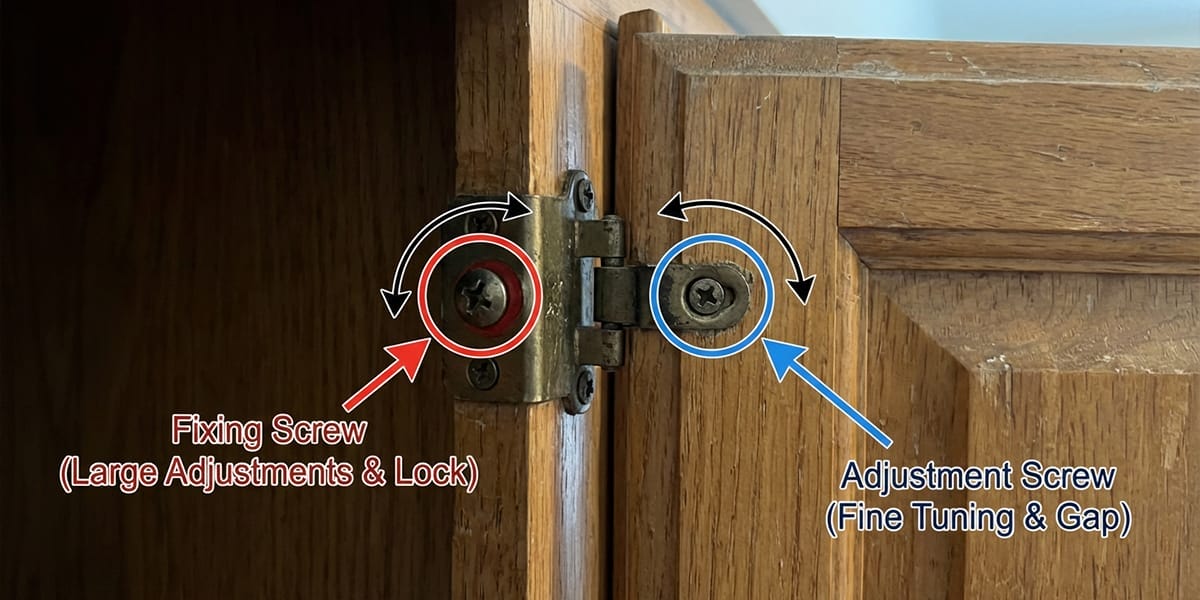
Fixing screw vs. Adjustment screw
Fixing screw: Primarily used to secure the hinge to the cabinet body or door. It allows larger-range positional adjustments and is used to lock the hinge once the overall position is set.
Adjustment screw: Located closer to the door, this screw is for small, fine adjustments. It controls the gap and the smoothness of the door’s movement for precise tuning.
Step-by-Step Adjustment Process
Before making any adjustments, it is important to check whether the fixing screws are properly positioned. First, slightly loosen all fixing screws. If the cabinet door has multiple hinges, all of them should be loosened at the same time. Hold the door by hand and make sure its top and bottom edges are vertical and aligned with the cabinet, while the door remains level with the cabinet side panel.
At the same time, observe each fixing screw and gently push the door to adjust the spacing between the door and the cabinet body. Try to keep all fixing screws within the middle range of their adjustment travel. Because of installation differences, it is unlikely that every hinge will sit in exactly the same position, but aiming for the middle range provides better balance. Once the position feels right, keep holding the door steady and tighten the fixing screws by turning them clockwise.
After that, open and close the cabinet door once to check how smoothly it moves. If everything works well, you are lucky and the job is already done. In most cases, however, one of the following situations may occur. You can then fine tune the adjustment screw based on the specific problem.
Three Common Cabinet Door Problems & Fixes
1. Doors Hitting Each Other
The first common issue is cabinet doors hitting each other. When two doors rub against or collide with one another, it means the distance between the two doors is too small. In this situation, the distance between the door and the cabinet body needs to be reduced by turning the adjustment screw clockwise.
If two doors are colliding, open both doors and observe the gaps between each door and the cabinet body. The side with the larger gap should be adjusted first. For example, if the gap on the left side is larger, turn the adjustment screw on the left door clockwise. When both gaps appear equal but the doors still touch, adjust the hinges on both sides at the same time.
2. Door Rubbing Against Cabinet Body
The second issue is rubbing between the cabinet door and the cabinet body. During opening or closing, the door may scrape against the cabinet, sometimes producing noise. When closing the door, it may fail to shut automatically and instead remain partially open. This usually happens when the distance between the door and the cabinet body is too small. In this case, turn the adjustment screw counterclockwise to increase the distance.
During this process, repeatedly open and close the door while observing whether the rubbing improves. Once the door no longer scrapes, the adjustment is complete. If adjusting one door causes the two doors to start colliding again, simply adjust the other door by turning its adjustment screw clockwise to restore balance.
3. Tilted / Crooked Door
The third issue is a tilted cabinet door. When a door appears crooked, it usually means the fixing screws were not properly adjusted. If the tilt is minor, however, it can often be corrected using only the adjustment screws.
First, check whether the tilted door is experiencing either of the previous two problems. For example, the upper part may be rubbing against the cabinet, or the lower part may be hitting the adjacent door. If so, adjust the hinge at the affected area, either the top or bottom, following the corresponding method described earlier.
If the door looks tilted but functions normally and only affects appearance, open the door and observe the gap between the door and the cabinet body. This gap will indicate which side is misaligned. The general rule is simple. Where the gap is larger, turn the adjustment screw clockwise. For instance, if the gap is wider at the top and gradually narrows toward the bottom, turn the adjustment screw on the top hinge clockwise until the gap matches the lower section and the door appears straight again.
When Cabinet Hinge Adjustment Is Not Enough
Adjusting concealed hinges can solve many common cabinet door issues, such as uneven gaps, rubbing doors, and misalignment. However, if cabinet problems continue because of damaged cabinet boxes, aging materials, or repeated repairs, the issue may go beyond hinge adjustment.
For homeowners planning a kitchen renovation, replacing outdated cabinetry can be a practical long-term solution. RTA kitchen cabinets offer an affordable way to upgrade your kitchen with modern styles, flexible layouts, and easier installation options.
FAQ
How do you adjust concealed cabinet hinges?
Most concealed cabinet hinges can be adjusted in three directions: side-to-side, up-and-down, and in-and-out. By turning the adjustment screws slowly with a screwdriver, you can correct uneven gaps, door alignment issues, and rubbing problems.
Why are my cabinet doors uneven?
Uneven cabinet doors are usually caused by loose hinge screws, incorrect hinge adjustment, cabinet installation issues, or normal movement over time. Adjusting the concealed hinges can often restore proper alignment.
Why is my cabinet door rubbing against the cabinet frame?
A cabinet door may rub against the frame when the hinge position changes or the gap between the door and cabinet box becomes too small. Adjusting the hinge depth or side-to-side position can usually fix this issue.
Can I adjust concealed hinges myself?
Yes. Most concealed hinges are designed for simple adjustments using a screwdriver. Homeowners can usually fix minor cabinet door alignment problems by following the adjustment steps carefully.
When should I replace cabinet hinges instead of adjusting them?
If hinges are damaged, worn out, loose, or unable to hold the cabinet door properly after adjustment, replacement may be necessary. For older kitchens with repeated cabinet issues, upgrading the cabinets may also be a better long-term solution.


About author

Related posts

Kitchen cabinet quotes can look similar at first but include very different products and services. One quote may include plywood cabinet boxes, finished end panels,... Continue reading

A knee drawer is a specialized vanity cabinet component designed to add storage while creating comfortable open space underneath a bathroom countertop. Knee drawers are... Continue reading

A 33-inch farmhouse sink is a common choice for a 36-inch base cabinet, but it is not a universal rule. The correct fit depends on... Continue reading

A kitchen cabinet filler is a narrow finished strip used to close or manage the space between a cabinet and a wall, appliance, corner, or... Continue reading

Choosing RTA cabinets involves more than comparing door styles or headline prices. You need to evaluate cabinet-box construction, door materials, available sizes, hardware, shipping, assembly,... Continue reading





Add comment