No products in the cart.
Return To Shop.png?sharp=1)




What Are the Most Common Bathroom Renovation Failures?
Bathroom renovations are often where the most mistakes happen. This article shares common renovation failures, explains why they occur, and provides advice on how to avoid them.
Table of Contents
1. Bathroom Vanity Water and Electrical Reservation Failures
The failure rate for water and electrical pre-installation in bathroom vanities is over 50 percent. This is not an exaggeration.
Corner Valve Height Too Low
Most modern vanities are wall-mounted, about 30 centimeters (11.81 in) above the floor, with an 8-centimeter (3.15 in) horizontal support bar for wall attachment. Installing the corner valve lower than 40 centimeters (15.75 in) can be troublesome, requiring cutting the support bar or adjusting the vanity height, which may result in an improper sink height. A corner valve height of 45 to 50 centimeters (17.72–19.69 in) is recommended. Choosing a two-layer split vanity is also fine.
Corner Valve Left and Right Positioning Incorrect
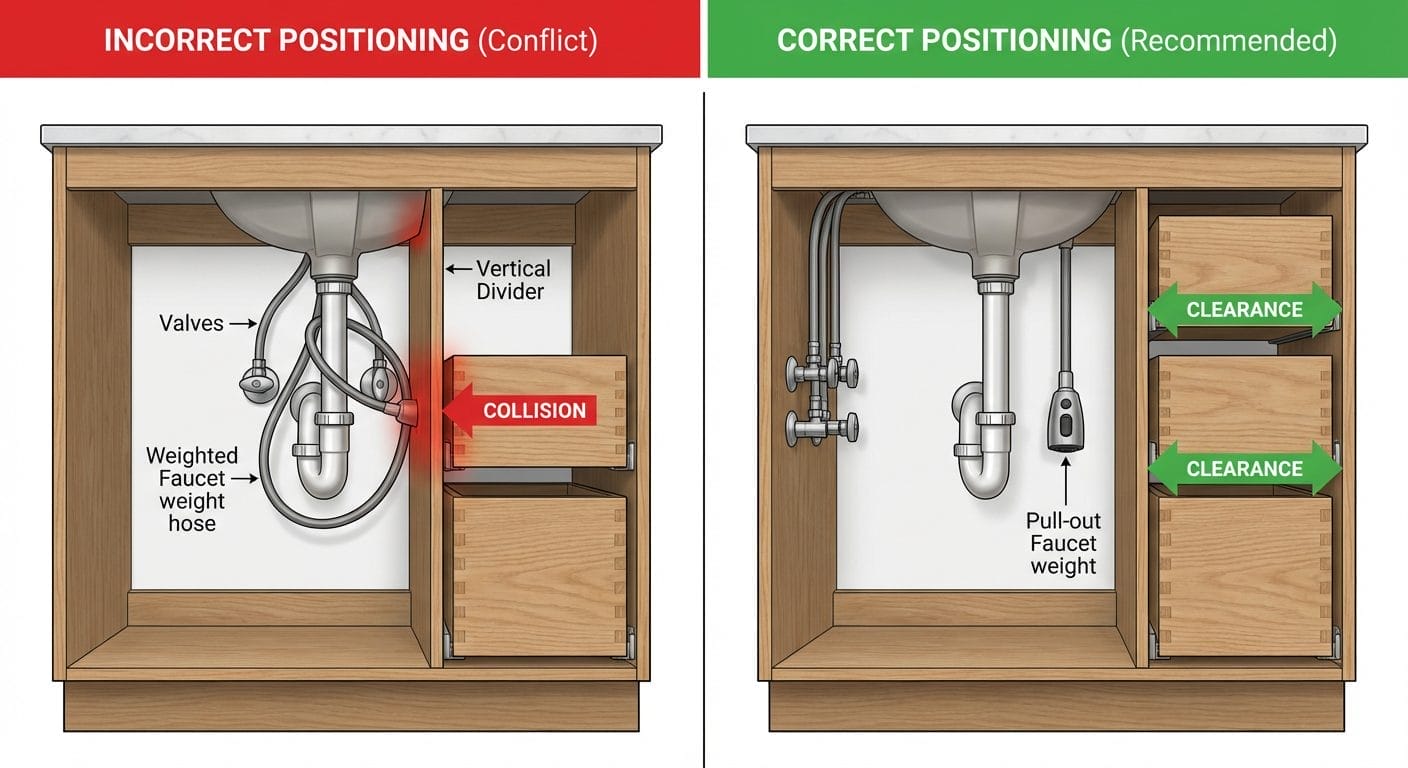
If the corner valve is reserved in the wrong horizontal position, it may conflict with vertical panels or drawers. This not only complicates installation but may require cutting the vanity and will make future replacements difficult. For misaligned corner valves, a double-door vanity is ideal, though for vanities wider than 80 centimeters (31.50 in), a three-door or drawer plus double-door combination is better.
Most vanities have drawers or single doors on the right, so the corner valve should be reserved on the left and not in the center. The sink drain is typically centered, and faucet hoses have weighted pull-out pipes. A centrally placed valve can obstruct faucet movement. Similarly, drain pipes should be slightly left of center.
If you plan to store a robot vacuum inside the vanity, the left 50-centimeter (19.69 in) area must be clear of corner valves, sockets, and drain pipes, or the vacuum cannot sit flush against the wall. For this setup, the vanity should be at least one meter (39.37 in) long, and the sink should be on the right rather than centered.
Wall Drain Position Incorrect
The wall drain height should match the corner valve height, and the horizontal position should not conflict with pull-out faucets. Ninety-degree wall drains provide better sealing than forty-five-degree ones.
Hairdryer Socket Position Incorrect
If the socket is too close to the wall where the hanging cabinet is installed, less than 15 centimeters (5.91 in), it prevents installing a cabinet. In such cases, only a mirror can be installed.
Smart Mirror Power Reservation Height Incorrect
If the power supply for a smart mirror is reserved too high, it will be exposed. The solution is to use a surface-mounted socket to hide the cable. The recommended hanging cabinet height is no more than 1.2 meters (47.24 in) above the floor. With a cabinet height of about 65 to 75 centimeters (25.59–29.53 in), the power line should be reserved at 1.85 meters (72.83 in), allowing it to be fully hidden behind the cabinet. For cabinets taller than 70 centimeters (27.56 in), the cable can be hidden inside without being visible when the door is closed.
2. Smart Toilet Water and Electrical Reservation Failures
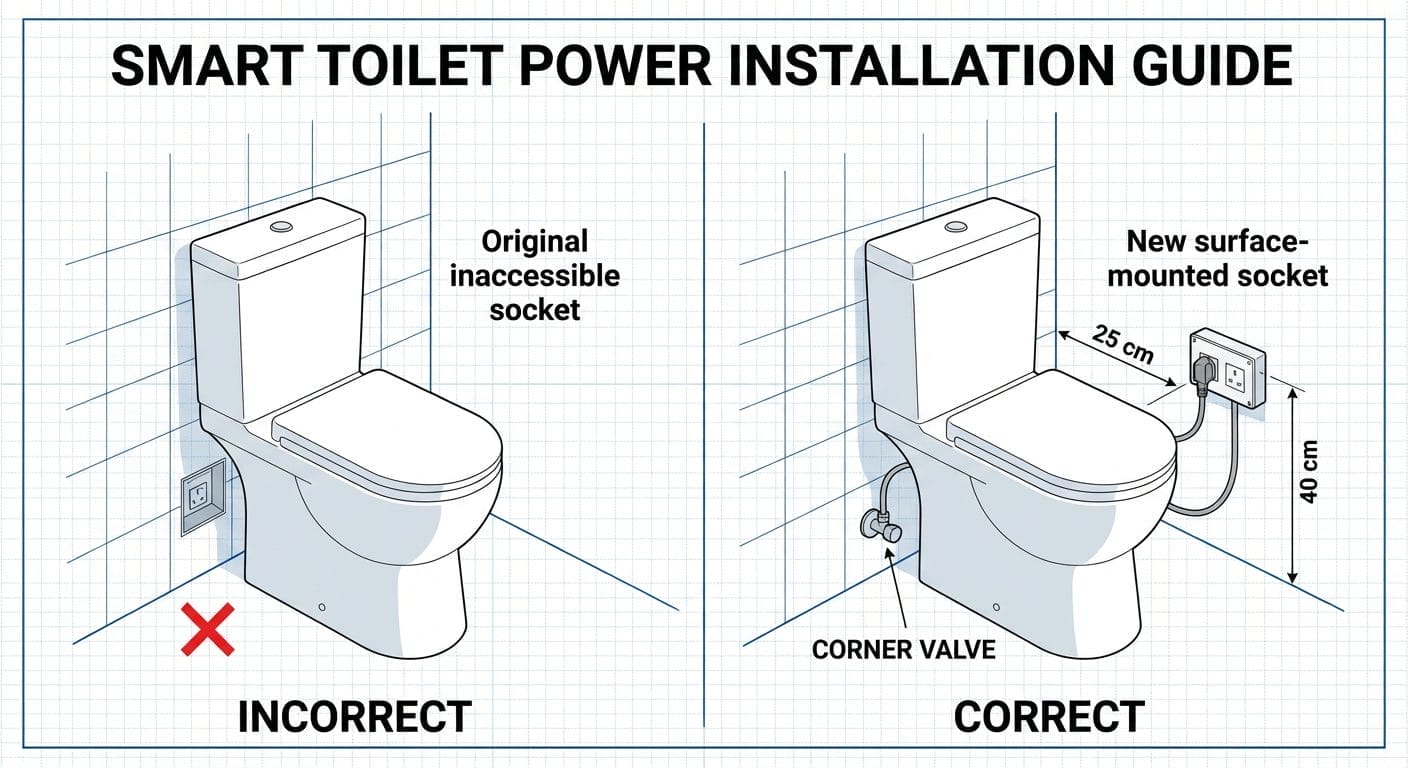
Smart Toilet Power Reservation Error
If the power socket is placed behind the toilet, it cannot be used once installed. The fix is to add a surface-mounted socket on the side and secure it to the wall. The socket should be about 25 centimeters (9.84 in) from the toilet center and on a separate side from the corner valve. The height should be around 40 centimeters (15.75 in), not exceeding the toilet height.
Corner Valve Height Too Low
If the corner valve is too low, installing the toilet spray or filter is difficult or impossible, and the spray hose may drag on the floor. The corner valve should be at least 25 centimeters (9.84 in) high, with 30 centimeters (11.81 in) being ideal.
Corner Valve Connected to Hot Water Pipe
Sometimes the corner valve is mistakenly connected to the hot water pipe. Always check and verify installation, and do not fully trust the installer. The solution is to connect the valve to the bathroom vanity’s water supply using a three-way valve and extend the supplied hose if needed.
3. Thermostatic Shower Installation Failures
If the hot and cold water lines are reversed, the shower cannot provide hot water. Always verify the water supply after electrical and plumbing work. When purchasing a thermostatic shower, confirm it can be properly installed. If discovered too late, negotiate with the seller to exchange or modify the main unit.
4. Electric Water Heater Water and Electrical Modification Failures
Outlet Position Incorrect
Common mistakes include placing the outlet too high or spacing the hot and cold pipes too far apart. The outlet spacing should be 10 centimeters (3.94 in), not 15, and the height should consider the ceiling and heater type. For cylindrical heaters, a ceiling height of 2.4 meters (94.49 in) works. For flat heaters or ceilings below 2.3 meters (90.55 in), pre-reserving at 1.6 meters (62.99 in) may cause problems.
Power Supply Reserved as a Regular Socket
Electric water heaters usually exceed 3000 watts, requiring a 16-amp three-prong socket. Many homeowners leave a standard socket, which prevents testing or operating the heater after installation.
Summary
Most bathroom renovation mistakes come from poor water and electrical planning. Always check corner valve heights, drain positions, sockets, and power outlets before installation. Verify plumbing and electrical work after renovation to ensure everything functions correctly. Careful planning and inspection prevent costly errors, making your bathroom safe, practical, and hassle-free.


About author

Related posts

Kitchen cabinet quotes can look similar at first but include very different products and services. One quote may include plywood cabinet boxes, finished end panels,... Continue reading

A knee drawer is a specialized vanity cabinet component designed to add storage while creating comfortable open space underneath a bathroom countertop. Knee drawers are... Continue reading

A 33-inch farmhouse sink is a common choice for a 36-inch base cabinet, but it is not a universal rule. The correct fit depends on... Continue reading

A kitchen cabinet filler is a narrow finished strip used to close or manage the space between a cabinet and a wall, appliance, corner, or... Continue reading

Choosing RTA cabinets involves more than comparing door styles or headline prices. You need to evaluate cabinet-box construction, door materials, available sizes, hardware, shipping, assembly,... Continue reading





Add comment