No products in the cart.
Return To Shop or
or  ,
,


Bathroom Vanity Installation Guide Essential Tips for a Better Result
Bathroom renovations often look simple on paper, yet anyone who has gone through one knows how many small decisions quietly affect daily comfort for years. Among all bathroom elements, the vanity cabinet is one of the most frequently used—and also one of the easiest to install incorrectly. Problems rarely appear on day one. They usually show up months or even years later. That is why vanity installation deserves more attention than it typically receives.
Table of Contents
Start With Accurate Measurements
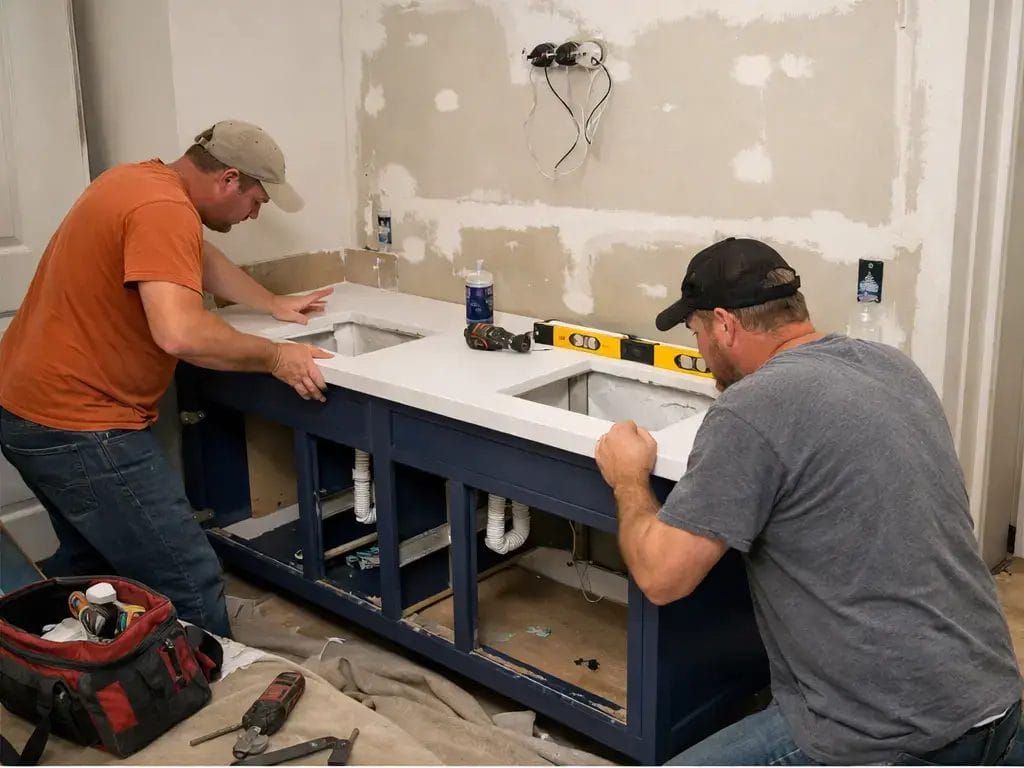
Measurement and space planning should begin early in the renovation process. If the vanity is installed against a single wall, allowances for toilet clearance and walking space are usually straightforward. However, when a vanity is installed between two walls, precision becomes critical. Even small errors can turn installation into a constant source of frustration.
Measure Finished Width, Not Rough Openings
One detail that is often overlooked is the difference between the cabinet body and the countertop. In most cases, the countertop is slightly wider than the cabinet below. Measurements should therefore be based on finished dimensions rather than rough openings.
If a sink has already been selected, its exact size should be confirmed with the contractor in advance. For example, for a 24-inch sink, it is recommended to reserve approximately 24.25 inches of finished width. This leaves a subtle gap—about one tenth of an inch on each side—that can later be sealed with caulking for a clean and stable finish.
Re-Measure If Walls Are Not Straight
In many homes, walls are not perfectly vertical or square. When construction accuracy is uncertain, remeasuring before final installation is always a wise decision. Custom-made bathroom cabinets are often a safer choice in these situations, as they allow better control over final dimensions and alignment.
Choose Wall-Mounted When Possible
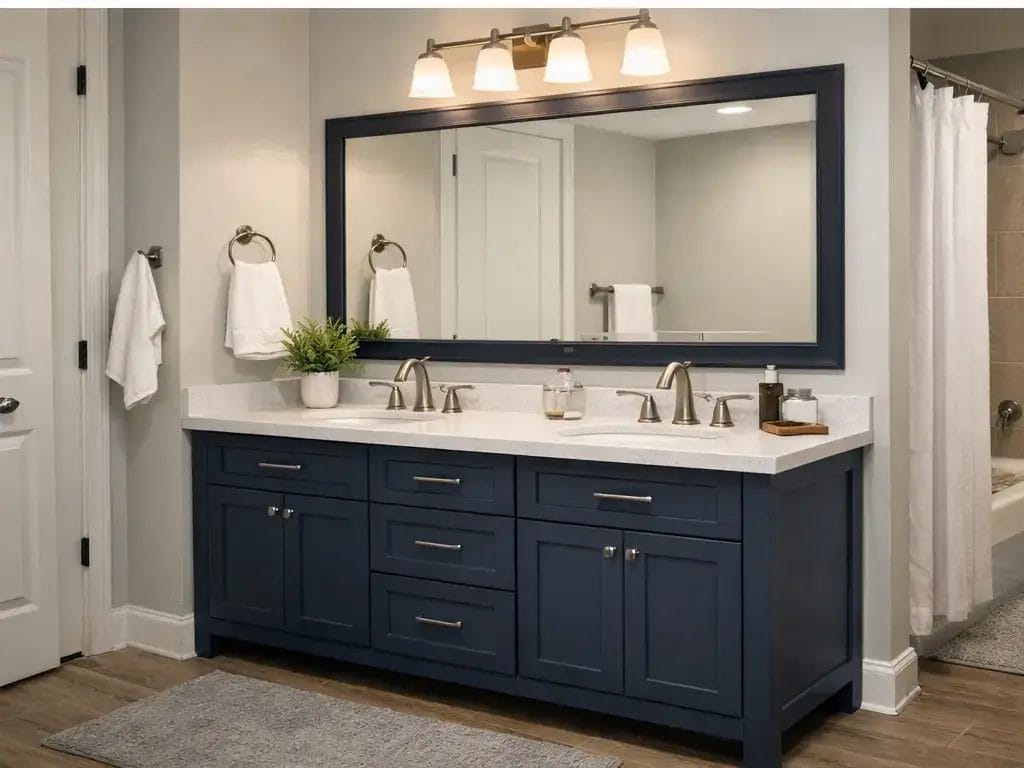
Whenever wall structure allows, wall-mounted vanity installation is worth prioritizing. Floating vanities are often chosen for their modern appearance, but their practical advantages matter even more in daily use.
Avoid Moisture Damage Over Time
One major benefit of a wall-mounted vanity is improved moisture protection. Even in well-maintained bathrooms, minor plumbing leaks or drainage issues can occur. With floor-standing cabinets that sit flush against the floor, trapped water is difficult to detect and even harder to dry.
Over time, this can lead to prolonged dampness, mold growth, and material deformation. This is especially problematic for fiberboard-based cabinets, which tend to swell when exposed to moisture. A floating vanity allows air to circulate underneath, making leaks easier to notice and dry out before serious damage occurs.
Use the Space Under the Vanity
The open area beneath a wall-mounted vanity provides flexible storage options. Items such as children’s bathtubs, cleaning buckets, or bathroom scales can be placed underneath without taking up cabinet space. This helps keep the bathroom organized while maintaining a more open and spacious visual effect.
Make Cleaning Easier
Cleaning becomes significantly easier when the cabinet does not touch the floor. Without legs or a sealed base, sweeping and mopping can be done quickly, with no hard-to-reach corners. A clearance height of around 12 inches is generally recommended, as it accommodates most cleaning tools and robotic vacuums.
Plan Drain Placement Early
Drain placement may seem like a minor detail, but it has a strong impact on both appearance and usability. Ideally, the drain pipe should be positioned close to the wall rather than emerging from the center of the floor. This allows the storage space beneath a floating vanity to remain open and unobstructed.
If the pipe extends too far outward, it becomes visually distracting and limits usable storage space. This issue is often overlooked during planning, so it is important to communicate clearly with the plumber early in the renovation process.
Avoid Using Backsplashes to Hide Gaps
Some installers recommend adding a backsplash strip between the countertop and the wall to conceal gaps. However, large gaps usually indicate underlying issues such as uneven walls or inaccurate measurements. While a backsplash may hide imperfections temporarily, it often collects dirt and mold over time, increasing maintenance effort.
Seal Cleanly Instead
When walls are properly leveled and measurements are accurate, the joint between the countertop and the wall can be finished cleanly with silicone sealant. This approach is simpler, more durable, and easier to maintain. If the gap is too large, addressing the construction issue directly is usually a better long-term solution than covering it with trim.
Focus on Long-Term Use
Bathroom vanity installation is more than a technical step in renovation—it directly affects how the space performs every day. Most long-term bathroom problems are not caused by bold design choices, but by overlooked details during installation.
By paying close attention to measurements, mounting style, plumbing layout, and finishing methods, you can avoid common issues and significantly improve daily comfort. Getting these fundamentals right results in a bathroom that is easier to use, easier to maintain, and more satisfying over time.


Related posts

Although the kitchen is often only a few square meters in size, it carries an enormous responsibility in daily life. It supports three meals a... Continue reading

I’ve designed more laundry rooms than I can count, and if there’s one thing I’ve learned, it’s this:a poorly planned laundry room will frustrate you... Continue reading

Choosing the right bathroom vanity can feel overwhelming—trust me, you’re not alone! In the United States, there’s no one-size-fits-all solution. Your perfect vanity depends on... Continue reading

I was camping in CS2 when a kitchen scene stopped me in my tracks — it looked exactly like a European farmhouse I’d seen in... Continue reading

I’ve been designing kitchens for over 20 years, and if there’s one thing I’ve learned, it’s that color matters — not just for aesthetics, but... Continue reading










Add comment