No products in the cart.
Return To Shop or
or  ,
,



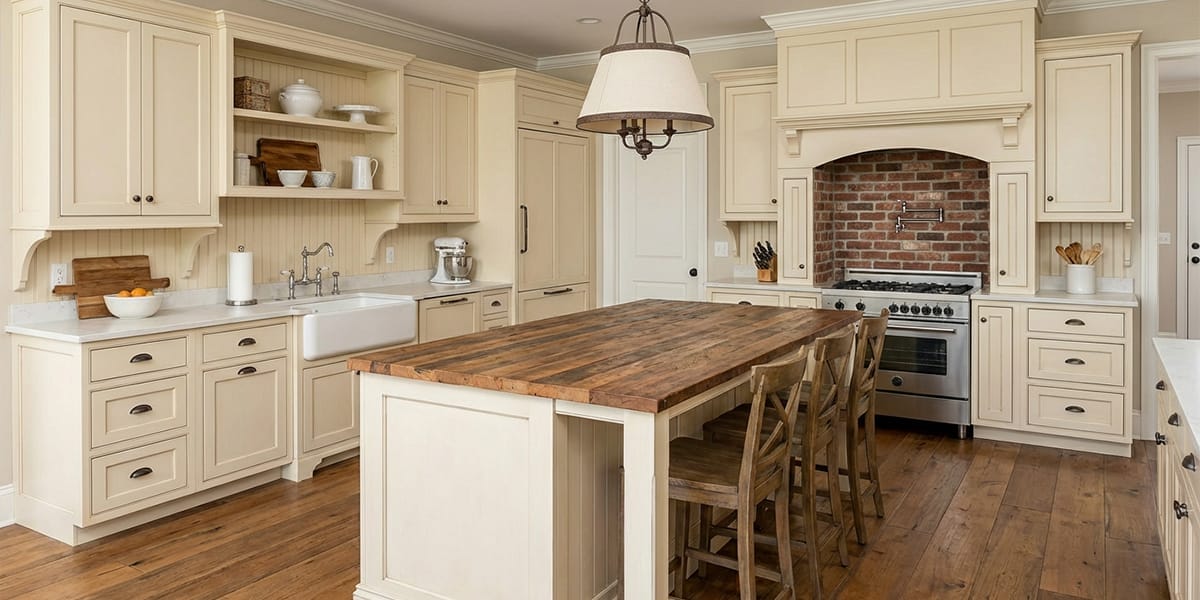
How to Design a Large Kitchen: Layout Planning and Smart Space Use
When you are fortunate enough to have a spacious kitchen, thoughtful planning becomes even more important than in a small one. A large kitchen offers great flexibility and freedom, but without a clear design strategy, the space may feel scattered, inefficient, or inconvenient to use. Through reasonable zoning, functional layout planning, smart storage, and proper appliance selection, a large kitchen can become both practical and comfortable — supporting daily cooking, family interaction, and modern lifestyle needs.
Table of Contents
Define Functional Zones Clearly to Improve Workflow
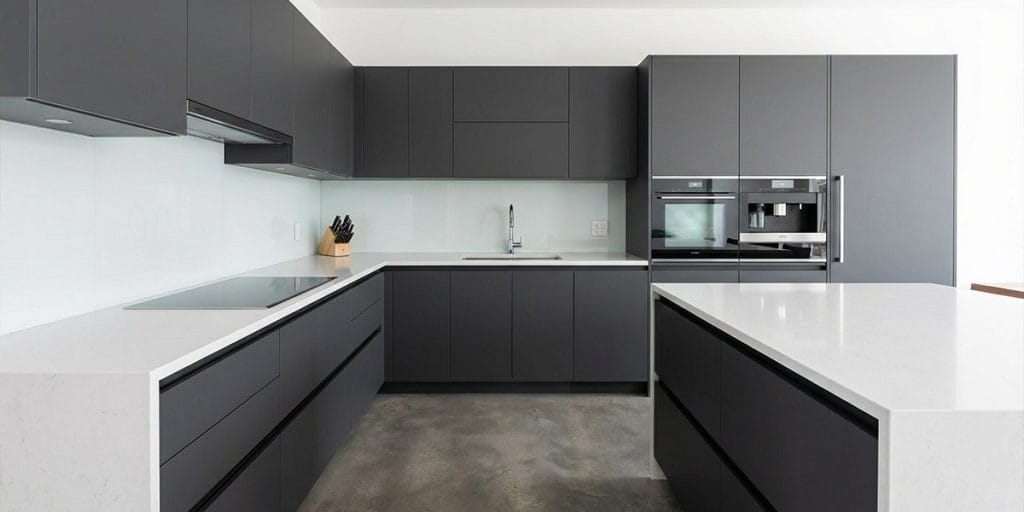
A well-organized large kitchen should begin with clear functional zoning. Typically, the space can be divided into:
- Cooking area
- Washing area
- Preparation area
- Storage area
To ensure smooth daily workflow:
- The cooking area should be arranged around the stove and oven to minimize unnecessary movement while cooking.
- The washing area works best near the sink and dishwasher to make cleaning ingredients and tableware easier.
- The preparation area should provide a generous countertop surface for chopping, mixing, and plating.
- The storage area is used for cookware, dishes, pantry items, and small appliances.
Where possible, the design should follow the classic kitchen work triangle principle (sink – stove – refrigerator), with recommended distances kept both efficient and comfortable for movement.
This helps reduce walking distance, improves cooking rhythm, and enhances the overall kitchen experience.
Choose a Suitable Cabinet Layout for Large Kitchen Spaces
The cabinet layout plays a decisive role in how effectively a large kitchen is used. Common layout options include:
- U-shaped layout
- L-shaped layout
- Island layout
U-Shaped Layout
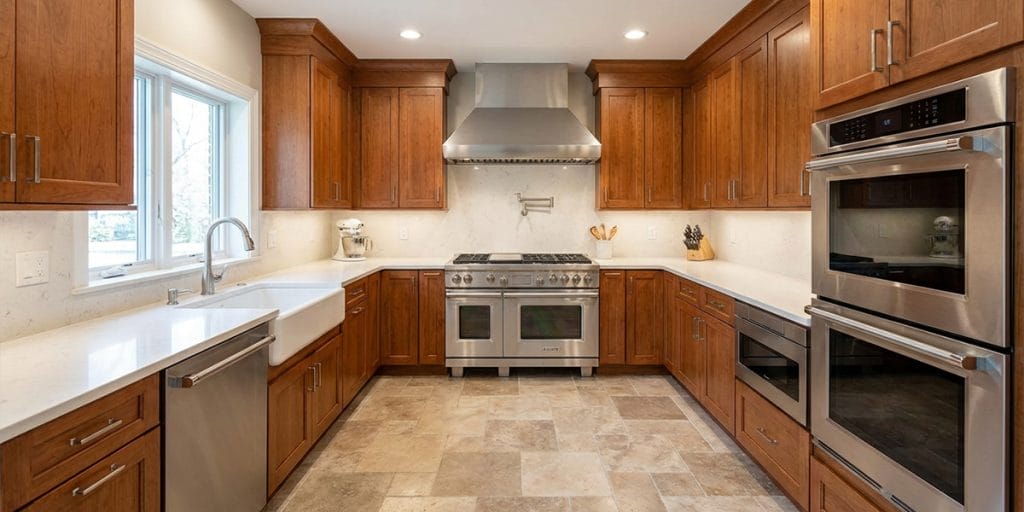
Ideal for larger spaces, providing:
- Continuous countertop workspace
- Strong storage capacity
- Smooth and efficient workflow
To optimize comfort, it is recommended that the aisle width remains around 100–120 cm to avoid crowding when multiple people work together.
L-Shaped Layout
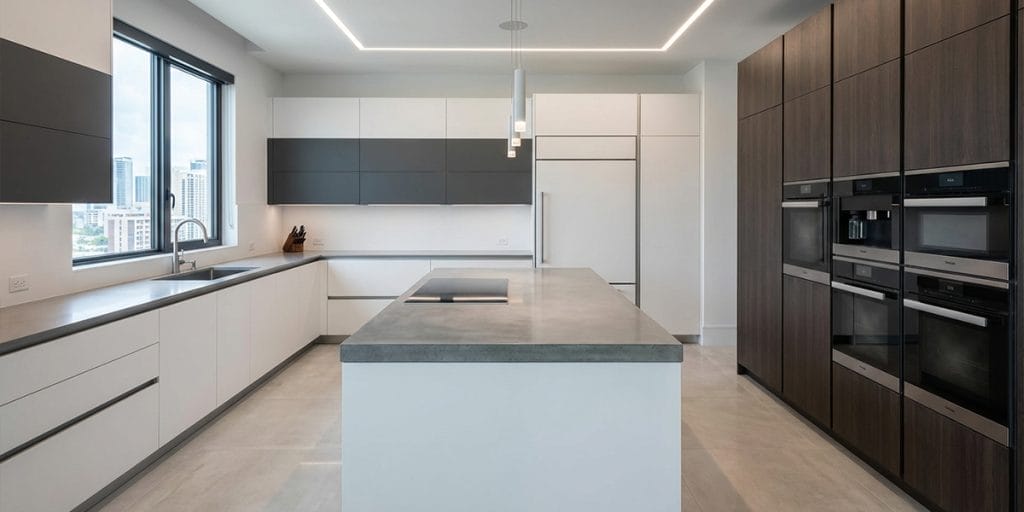
More flexible and suitable for rectangular or open kitchens:
- Makes good use of corners
- Keeps traffic paths open
- Creates natural room flow
If space allows, the L-shaped layout can be paired with an island to enhance functionality.
Island Layout
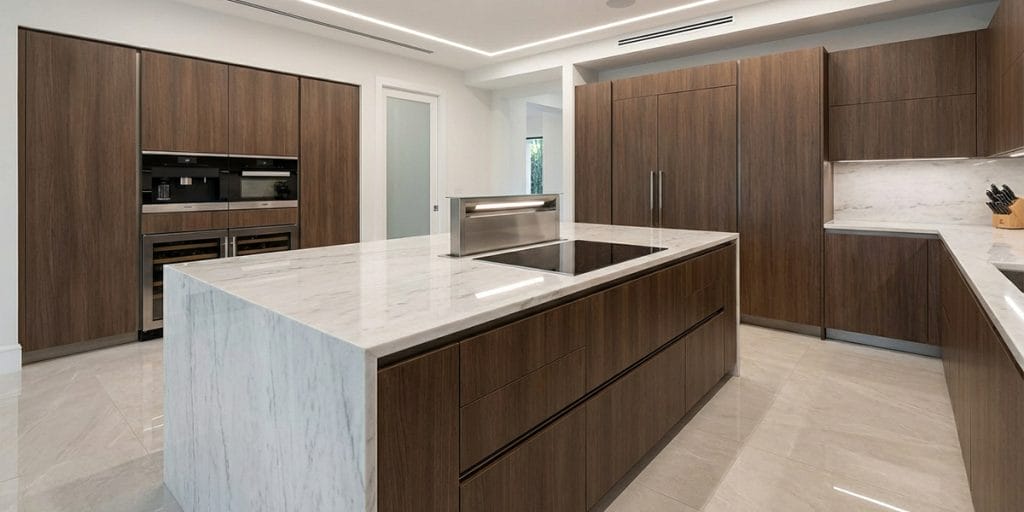
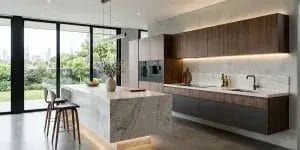
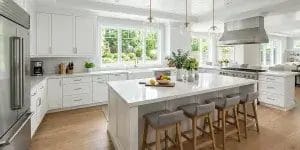
A highly popular choice in modern large kitchens, offering:
- Extra preparation and dining space
- Additional drawers and storage cabinets
- A visual and social centerpiece
For better usability:
- Recommended island length: ≥ 150–180 cm
- Suggested passage around island: 90–110 cm
This ensures comfort whether cooking alone or sharing the kitchen with family.
Maximize Storage and Make Organization More Efficient

One of the greatest advantages of a large kitchen is the ability to create systematic storage planning.
Practical storage solutions include:
- Tall cabinets extended up to the ceiling to reduce dust buildup
- Drawer systems for pans, utensils, and small tools
- Pull-out baskets for deep cabinets
- Corner pull-out units to utilize blind corners
- Upper cabinets combined with open shelves for frequently used items
A helpful guideline is to balance:
- Closed storage (for a tidy appearance)
- Open or display storage (for convenience and style)
With thoughtful organization, the kitchen remains neat and efficient — even when storing a large number of items.
Consider Adding a Kitchen Island as a Functional Centerpiece
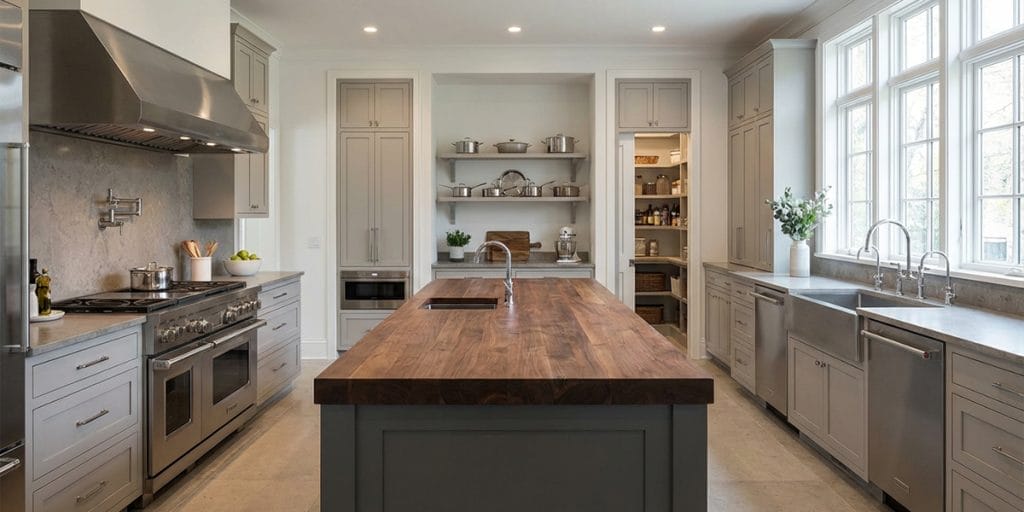
If space permits, a kitchen island can significantly enhance practicality and spatial interaction. An island can be used for:
- Food preparation and serving
- Light dining or breakfast seating
- Additional storage drawers and cabinets
- Separation of cooking and living zones
In families that enjoy cooking together or entertaining guests,
the island often becomes the emotional and functional center of the kitchen.
Use Layered Lighting to Enhance Both Function and Atmosphere
Lighting plays a key role in large kitchen comfort. A layered approach works best:
- Ceiling lighting for general illumination
- Under-cabinet task lighting for work surfaces
- Cabinet interior sensor lighting for storage areas
- Pendant lighting above the island to create a warm focal point
This ensures that the kitchen is:
- Practical for cooking
- Comfortable for dining
- Visually welcoming for gatherings
Select Reliable, High-Capacity Kitchen Appliances
A spacious kitchen allows greater flexibility in appliance selection, such as:
- Double-door or French-door refrigerators
- Built-in ovens and microwaves
- High-capacity dishwashers
Integrating appliances into cabinetry improves both appearance and usability, while maintaining a coherent design style.
At the same time, electrical outlet planning should be considered in advance:
- Each functional zone should include sufficient outlets
- Switch-controlled outlets improve safety and convenience
Ensure Good Ventilation and Heat Management
Large kitchens often include multiple high-power appliances, making ventilation especially important.
Recommended planning includes:
- A powerful and properly positioned range hood
- Adequate air circulation and exhaust routing
- Heat dissipation space for refrigerators and ovens
Good ventilation keeps the kitchen fresh and comfortable while helping extend appliance lifespan.
Comparison of Different Kitchen Layout Designs
| Design type | Advantages | Disadvantages |
|---|---|---|
| U-shaped layout | Large countertop area, high storage capacity, smooth and efficient workflow | Requires more space, corner areas may be less efficiently used |
| L-shaped layout | Flexible arrangement, suitable for various room shapes, saves circulation space | Limited countertop length compared to U-shape |
| Island layout | Adds workspace and storage, improves interaction, creates a visual focal point | Requires sufficient floor area and usually higher investment |
Cabinet Selection: Function, Durability, and Value Should Stay in Balance
Regardless of kitchen size, cabinet quality and storage planning play a decisive role in both functionality and appearance.
When choosing cabinets — whether custom-made or ready-made — it is important to consider:
- Structural durability
- Material and finish quality
- Storage configuration
- Visual coordination with the space
Brands such as RaraRTAcabinets provide a wide range of:
- RTA (Ready-to-Assemble) cabinets
- Pre-assembled cabinet options
These solutions combine:
- Factory-level durability
- Practical storage design
- Competitive pricing advantages
They are suitable for both large kitchens and compact kitchens, helping homeowners achieve better organization, layout flexibility, and aesthetic balance.
Conclusion
A large kitchen is not only a cooking space — it is also a place for family interaction, lifestyle expression, and everyday comfort. By focusing on:
- Functional zoning
- Workflow and layout
- Smart storage planning
- Lighting and ventilation
- Appliance integration
the space can become efficient, visually appealing, and enjoyable to use.
With systematic planning and thoughtful material choices, both large and small kitchens can achieve a comfortable, well-organized, and high-quality cooking environment.


About author

Related posts

For years, homeowners on Reddit’s r/kitchenremodel and r/DesignMyRoom have asked the same question: “Are two-tone kitchen cabinets a timeless classic, or just a trendy style... Continue reading
When people shop for new cabinet doors, they often focus on color, style, or finish first. That makes sense. But in real home projects, the... Continue reading
Painting bathroom cabinets is not the same as painting a dresser or a living room shelf. A bathroom is a humid space, which means the... Continue reading
Floating cabinets are beautiful. They make a space feel lighter, cleaner, and more refined. No bulky legs, no visual clutter — just a clean, modern... Continue reading
Cabinets take up a large part of any kitchen, bathroom, or laundry room. When the color no longer feels right, the whole space can start... Continue reading







Add comment