No products in the cart.
Return To Shop.png?sharp=1)



How to Choose Kitchen Cabinet Materials Before You Buy
Choosing kitchen cabinet materials requires more than comparing solid wood, plywood, MDF, HDF, and particleboard by name. A cabinet may use different materials for its box, doors, shelves, drawer components, and face frame, so the right choice depends on where each material is used and how the complete cabinet is built.
Before buying cabinets, evaluate five key factors: component use, moisture exposure, surface finish, construction specifications, and warranty coverage. These factors provide a more accurate comparison than broad labels such as “all wood” or “plywood construction.”
This guide explains how to apply those five factors to real cabinet specifications, distinguish structural materials from surface finishes, and choose cabinet construction that fits your kitchen, maintenance expectations, and project priorities.
For a closer look at how these materials are used specifically in ready-to-assemble cabinetry, see our guide to whether RTA cabinets are made from real wood.
Table of Contents
Factor 1: Match Each Material to the Cabinet Component
When asking what kitchen cabinets are made of, start by identifying each component. Cabinet boxes, doors, face frames, shelves, back panels, and drawer components perform different jobs, so a well-built cabinet may combine several materials. Plywood may be used for the cabinet box, solid wood for a face frame or door frame, and MDF or HDF for a painted door panel. Judge each material by where it is used and how the complete cabinet is constructed, not by the material name alone.
| Material | Common Cabinet Uses | Main Advantages | What to Check |
|---|---|---|---|
| Solid Wood | Door frames, face frames, drawer fronts, decorative parts | Natural grain, repairable, stainable, strong | Wood species, finish quality, moisture movement, cost |
| Plywood | Cabinet boxes, shelves, backs, drawer components | Good structural strength, dimensional stability, relatively lightweight | Panel thickness, veneer quality, number and quality of plies, edge construction |
| MDF | Painted doors, center panels, decorative panels | Smooth surface, consistent finish, good for painted applications | Edge sealing, moisture exposure, panel thickness |
| HDF | Some painted doors and high-density panels | Dense, smooth, and suitable for finished surfaces | Product specifications, weight, moisture protection |
| Particleboard | Cabinet boxes, shelves, and panels in some cabinet lines | Flat, consistent, generally lower cost | Density, fastener holding, edge sealing, moisture protection |
Factor 2: Compare Solid Wood and Engineered Wood by Use
After identifying where each material is used, compare solid wood and engineered wood according to the job each component must perform. Solid wood is often selected for visible frames, doors, and decorative components, while engineered panels may provide consistent dimensions and smooth finished surfaces for cabinet boxes, shelves, and painted door panels. Neither category guarantees better quality by itself. Compare the exact wood species or panel grade, thickness, construction, finish, moisture protection, and intended use.
Solid Wood
Solid wood is most useful in cabinet components where natural grain, staining, repairability, or traditional joinery matters. It is commonly used for face frames, door frames, drawer fronts, mouldings, and decorative parts rather than every component of the cabinet box.
Before buying, confirm the exact wood species, which cabinet components use solid wood, how those components are joined, and whether the finish is painted, stained, or clear-coated. A solid wood label alone does not determine the quality of the complete cabinet.
Hardwood

Hardwood species commonly used in cabinetry include oak, maple, cherry, walnut, and birch. Depending on the species and construction, hardwood may be used for door frames, face frames, drawer fronts, and other visible components where natural grain or a stained finish is important.
Hardwood can be a suitable choice when you want visible wood character, refinishing potential, or durable framed components. However, the term “hardwood” does not guarantee that every species has the same hardness, stability, or resistance to dents.
Before buying, check the exact species, the components that use it, the door and frame construction, the finish quality, and the manufacturer’s care requirements. Also confirm whether center panels and other less-visible components use solid wood, veneer, MDF, HDF, or another material.
Softwood
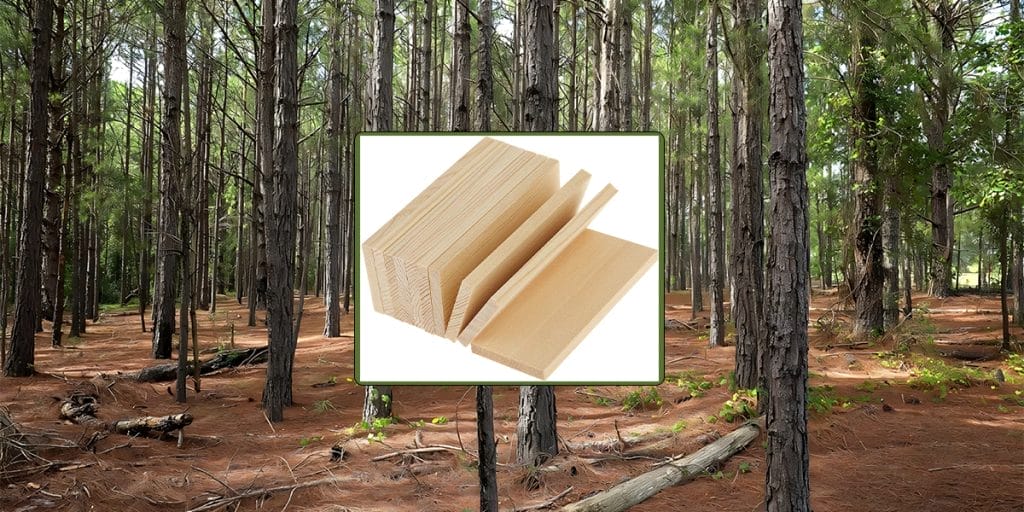
Softwood species used in cabinetry and interior millwork may include pine, fir, and spruce. They can provide lighter colors, distinctive grain patterns, and a natural appearance for doors, decorative components, and specific cabinet styles.
Softwood may suit a project where natural character and a particular wood appearance are more important than maximum dent resistance. Performance varies by species, and some softer woods may show dents or everyday wear more readily than denser cabinet woods.
Before buying, confirm the exact species, where it is used, the thickness and construction of the component, the protective finish, and the available repair or refinishing options. Evaluate the complete specification rather than treating the softwood label as a quality grade.
Hardwood vs Softwood: What Buyers Should Compare
| Comparison Point | Hardwood | Softwood |
|---|---|---|
| Common Examples | Oak, maple, cherry, walnut, and birch | Pine, fir, and spruce |
| Common Cabinet Uses | Door frames, face frames, drawer fronts, and decorative components | Selected doors, decorative components, millwork, and style-specific applications |
| Appearance | Wide range of grain patterns, colors, and stain results | Often lighter in color with distinctive grain, depending on the species |
| Dents and Everyday Wear | Varies by species; many cabinet hardwoods provide relatively good dent resistance | Varies by species; some softer woods may show dents and wear more readily |
| Moisture and Humidity | Can expand or contract as humidity changes; construction and finish matter | Can also respond to humidity changes; species, construction, and finish matter |
| Best Suited For | Visible natural grain, stained finishes, framed components, and refinishing potential | Projects that prioritize a particular natural appearance, lighter wood tone, or distinctive grain |
| What to Verify | Exact species, component use, joinery, finish quality, and warranty | Exact species, component use, dent resistance, finish protection, and care requirements |
Buying takeaway: Choose between hardwood and softwood by comparing the exact species, cabinet component, finish, expected wear, and maintenance requirements. Neither label alone explains the quality or durability of the complete cabinet.
Engineered Wood
Engineered wood products are widely used in cabinetry, furniture, and construction. Unlike solid wood, they are manufactured from wood veneers, fibers, or particles combined with adhesives or resins. Common cabinet materials in this category include plywood, MDF, HDF, and particleboard.
Different engineered wood products have different structures and performance characteristics, so they should not be treated as interchangeable. The best choice depends on where the panel is used, its thickness, manufacturing quality, edge construction, moisture exposure, and finish.
Plywood
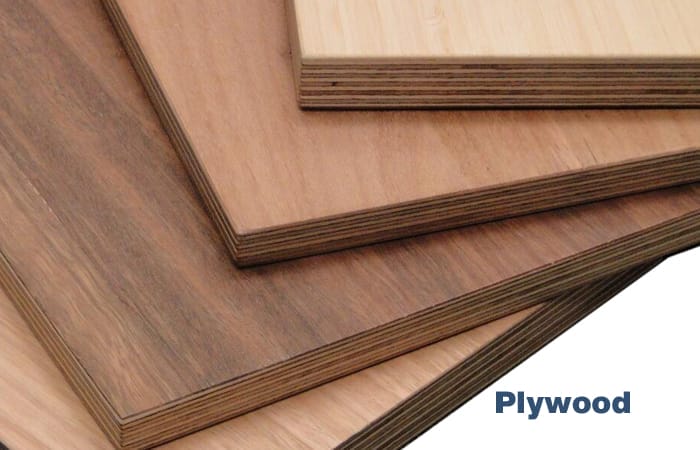
Plywood is an engineered wood panel made from thin wood veneers bonded in layers, usually with the grain direction alternating between adjacent layers. In kitchen cabinets, plywood is commonly used for cabinet boxes, shelves, back panels, and drawer components.
Plywood can be a suitable choice when structural strength, dimensional stability, fastener holding, and manageable cabinet weight are important. However, the word “plywood” alone does not confirm the quality of a cabinet. Performance varies according to the panel grade, thickness, veneer and core construction, edge treatment, and manufacturing quality.
Before buying, confirm exactly where plywood is used. Check the thickness and construction of the cabinet box, shelves, back panels, drawer components, and toe kick separately. Also review the shelf spans, joinery, exterior finish, exposed edges, and the way hardware is attached.
A higher number of plies does not automatically make one cabinet better than another. Compare the complete panel specification and the finished cabinet construction rather than relying only on ply count or a general “plywood construction” label.
Plywood edges and damaged surface areas should be protected from prolonged moisture exposure. Suitability near sinks, dishwashers, and other water sources depends on the panel, edge sealing, finish, installation, and ongoing care.
Buying tip: If a cabinet is advertised as using plywood, verify which components actually contain plywood and which use solid wood, MDF, HDF, particleboard, or another material. Also review the cabinet warranty to understand what materials, components, finishes, environmental conditions, and types of damage are covered.
MDF
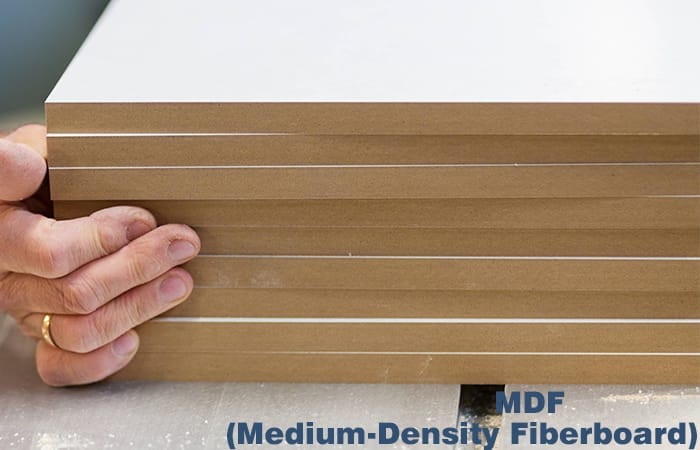
MDF, or Medium-Density Fiberboard, is an engineered wood panel made from wood fibers combined with a bonding system and pressed into a dense, uniform panel. Its smooth surface and consistent internal structure make it especially suitable for painted and machined cabinet components.
In kitchen cabinets, MDF may be used for painted door panels, slab doors, routed profiles, mouldings, and decorative panels. For Shaker-style doors, MDF may be used only for the center panel or for additional door components, depending on the specific door construction. A slab door does not have a separate center panel, so the MDF may form the primary door substrate.
MDF can be a suitable choice when a smooth painted finish, consistent machining, and minimal visible wood grain are priorities. It is less suitable when the project requires a natural stained-wood appearance unless a real-wood veneer or another decorative surface is applied.
Before buying, confirm exactly which components use MDF. Check the panel thickness, product grade, intended application, moisture rating where provided, edge sealing, surface finish, and the way hinges or other hardware are attached.
Unfinished, damaged, or poorly sealed MDF edges should be protected from prolonged moisture exposure. Performance depends on the specific panel, finish, edge protection, installation conditions, and ongoing care rather than the MDF label alone.
Buying tip: MDF used in a painted cabinet door is a different construction decision from MDF used for the cabinet box, shelves, or other structural components. Evaluate each component separately and compare the complete cabinet specification.
HDF
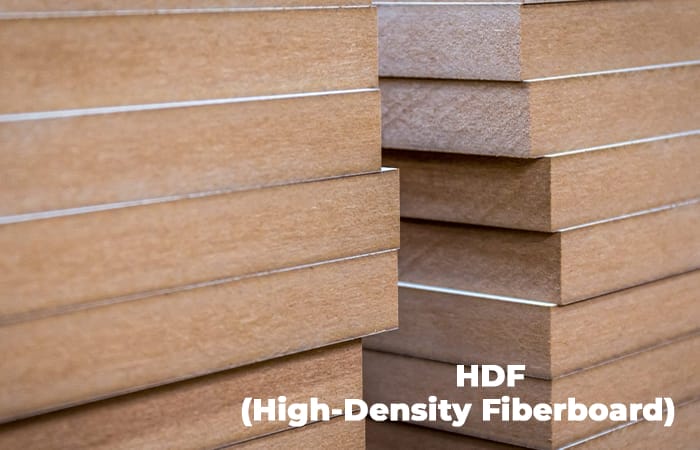
HDF, or High-Density Fiberboard, is a dense fiber-based engineered wood panel. Depending on the manufacturer and product specification, material marketed as HDF may be a higher-density product within a broader MDF range rather than a universally separate cabinet-material category.
In cabinetry, HDF or other higher-density fiberboard products may be used for painted doors, routed panels, decorative components, and other applications that benefit from a dense, uniform surface. Higher density may affect machining, weight, and mechanical properties, but it does not automatically make a panel more suitable for every cabinet component.
Before buying, confirm which cabinet components use HDF and compare the exact panel grade, thickness, intended application, surface finish, edge protection, moisture rating where provided, and manufacturer specifications.
MDF vs HDF
| Feature | MDF | HDF / Higher-Density Fiberboard |
|---|---|---|
| Basic Construction | Wood fibers bonded and pressed into a uniform panel | Similar fiber-based construction, typically produced at a higher density |
| Surface | Smooth and uniform | Smooth and dense |
| Common Cabinet Uses | Painted doors, center panels, slab doors, mouldings, and decorative panels | Certain painted doors, routed panels, specialty door components, and other high-density panel applications |
| Machining | Suitable for routing, shaping, sanding, and painting | Can provide a dense surface for detailed machining, depending on the specific product |
| Weight | Varies by panel density and thickness | Generally heavier than a lower-density panel of the same dimensions |
| Moisture Performance | Depends on panel grade, edge protection, and finish | Also depends on the specific panel grade, moisture rating, edge protection, and finish |
| Strength | Depends on grade, thickness, and product specifications | Higher-density products may have different mechanical properties, but density alone does not determine overall cabinet quality |
| What to Check | Thickness, grade, intended use, moisture rating, and finish | Exact product specification, density/grade, intended use, moisture rating, and finish |
Buying tip: Do not choose a cabinet only because its specifications mention HDF instead of MDF. Compare where the material is used, the panel grade and thickness, the complete door or cabinet construction, the finish, edge protection, moisture requirements, and warranty coverage. For painted cabinet doors, the quality of the complete door construction and finish is usually more useful than the MDF or HDF label alone.
Particle Board
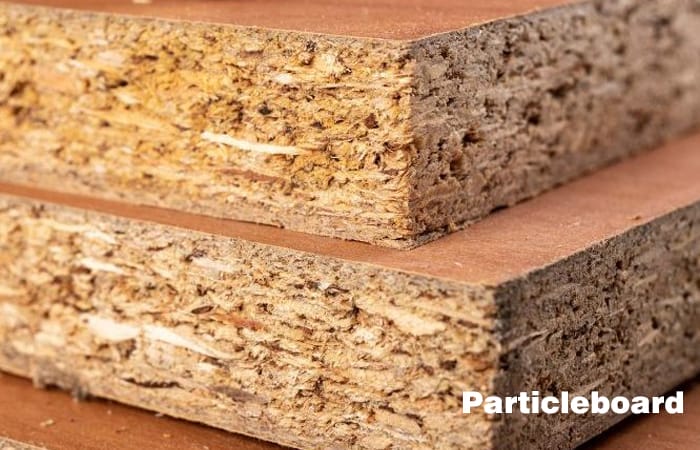
Particleboard is an engineered wood panel made from wood particles combined with a bonding system and pressed into a flat, consistent panel. In kitchen cabinets, it may be used for cabinet boxes, side panels, shelves, back panels, and other components, depending on the product grade and construction.
Particleboard commonly serves as a substrate for melamine, thermally fused laminate, and other decorative surfaces. It can be suitable for specific cabinet components when the panel grade, thickness, edge treatment, shelf support, and fastening system match the intended application.
Before buying, confirm exactly which components use particleboard. Check the panel thickness and grade or density, back-panel construction, shelf depth and span, edge banding or sealing, surface finish, joinery, and the way hinges, drawer hardware, and other fasteners are attached.
Exposed or damaged edges should be protected from prolonged moisture exposure. Shelf performance and fastener holding vary according to panel density, thickness, span, load, hardware, and manufacturing quality, so these characteristics should not be judged from the material name alone.
Buying tip: Do not accept a general material label as a complete cabinet specification. Compare particleboard component by component with plywood, MDF, HDF, or solid wood alternatives, and review the finish, hardware, installation requirements, and warranty together.
Factor 3: Separate the Core Material from the Surface Finish
Cabinet specifications often combine a structural material with a visible surface finish, but these are not the same thing. Plywood, MDF, HDF, and particleboard may form the substrate or core, while paint, stain, laminate, thermofoil, or wood veneer creates the visible surface. Before buying, confirm both the core material and the finish used for each cabinet component.
Evaluate the finish for cleaning requirements, heat and moisture exposure, edge protection, repairability, and warranty coverage. For a more detailed comparison focused specifically on cabinet doors, review our cabinet door materials and finishes guide.
Laminate
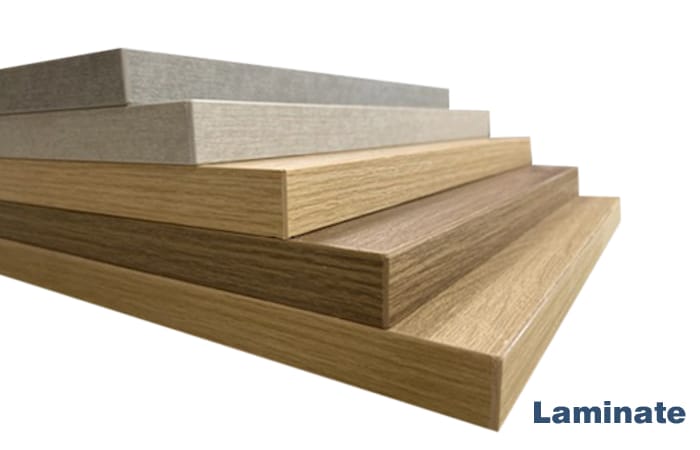
Laminate is a decorative surface applied to a substrate such as MDF, particleboard, plywood, or another suitable panel. It may be used on cabinet doors, side panels, interiors, shelves, and other finished components. Because laminate is a surface rather than the primary structural material, always confirm what material is underneath it.
High-pressure laminate, or HPL, is manufactured as a separate layered sheet and then bonded to a substrate. Thermally fused laminate, or TFL, uses a decorative resin-treated layer fused directly to the panel. These products should not be treated as identical because their construction, thickness, edge treatment, and intended applications may differ.
Laminate can provide consistent colors, wood-grain patterns, textures, and surfaces that are generally straightforward to clean. Resistance to scratches, stains, impact, heat, and moisture varies according to the specific laminate, substrate, edge construction, and product specifications.
Before buying, confirm whether the surface is HPL, TFL, or another laminated product. Check the underlying substrate, laminate specification, edge banding, exposed seams, door or panel construction, cleaning instructions, and warranty coverage.
Buying tip: Pay particular attention to edges and openings around hardware. If moisture reaches an unfinished or damaged edge, the underlying substrate may be affected even when the laminate surface remains intact. Deep chips and damaged edges may also be more difficult to repair without a visible difference.
Thermofoil
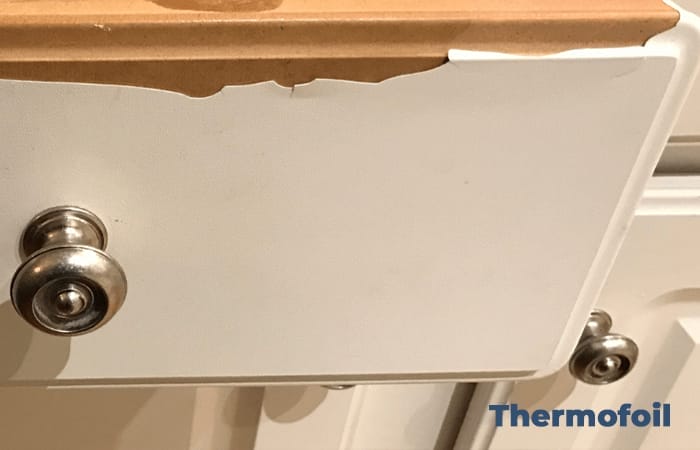
Thermofoil is a flexible decorative film formed and bonded over a shaped cabinet-door or drawer-front substrate using heat and pressure. MDF is commonly used as the underlying core because its smooth, uniform surface can be routed into slab or profiled door designs before the film is applied. Thermofoil describes the surface treatment, not the structural material underneath it.
Thermofoil doors are available in solid colors, wood-grain patterns, matte finishes, and gloss finishes. Depending on the product, the film may wrap across the face and shaped edges to create a consistent appearance. Buyers should still check the back surface, edge coverage, seams, and underlying core material.
Heat exposure is an important installation consideration. Cabinets positioned near ovens, ranges, countertop appliances, and other heat-producing equipment should follow the cabinet and appliance manufacturers’ clearance and heat-protection requirements. Prolonged heat may affect the film or its bond to the substrate.
Cuts, lifted edges, damaged seams, or separated film may allow moisture to reach the underlying panel. Repairs can be difficult to blend with the surrounding surface, particularly when the film has peeled or changed color.
Buying tip: Before choosing thermofoil cabinets, check the door-core material, film or finish specification, front and edge coverage, back-surface finish, heat-clearance requirements, cleaning instructions, replacement availability, and warranty coverage.
Veneer
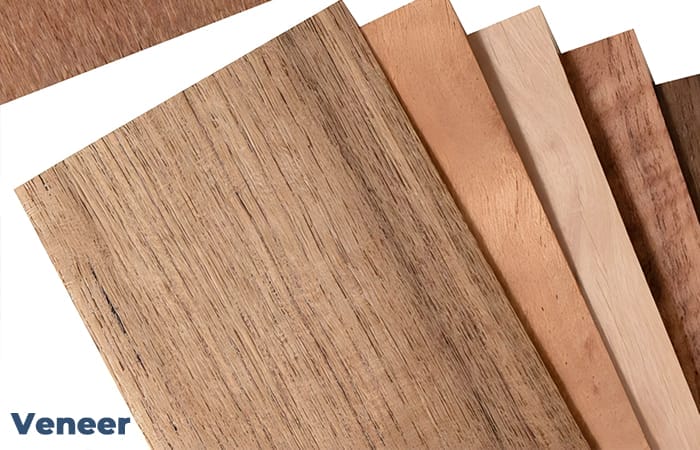
Wood veneer is a thin layer of real wood bonded to a substrate such as plywood, MDF, particleboard, or another suitable panel. The veneer provides the visible wood grain and color, while the underlying substrate provides most of the component’s structure. A veneered cabinet component is therefore not the same as a component made entirely from solid wood.
Wood veneer may be used on cabinet doors, drawer fronts, finished side panels, decorative panels, and other visible surfaces. It can be suitable when you want a natural wood appearance while using an engineered panel underneath for the required component construction.
Appearance varies according to the wood species, veneer-cutting method, grain matching, stain, clear coat, and panel layout. Because the visible layer is real wood, natural variations in grain and color should be expected, and the surface may change gradually with light exposure.
Before buying, confirm the wood species, underlying substrate, cabinet components that use veneer, grain-matching method, edge treatment, surface finish, cleaning requirements, and warranty coverage. Also check whether the product uses real wood veneer or a printed wood-look laminate.
Deep scratches, chips, damaged edges, or moisture reaching the substrate may be more difficult to repair without a visible difference. Repairability depends on the veneer, finish, depth of the damage, substrate, and availability of matching materials.
Buying tip: Evaluate the veneer and its substrate together. The appearance comes from the real wood surface, but the performance of the complete component also depends on the core panel, adhesive system, edge construction, finish, installation, and ongoing care.
Factor 4: Check Moisture Exposure, Emissions, and Material Sourcing
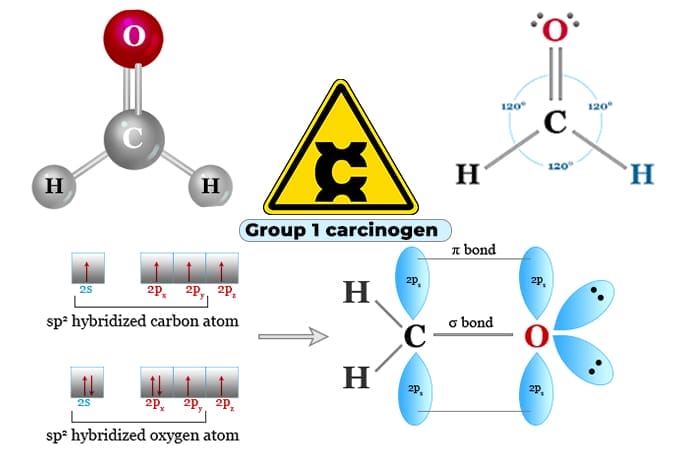
Before choosing cabinet materials, consider the conditions in which the cabinets will be used. Moisture can enter through unfinished or damaged edges, while composite wood panels may be subject to formaldehyde-emission requirements. Review edge sealing, surface protection, moisture exposure, and compliance information for the specific cabinet components.
Material sourcing and emissions compliance are separate considerations. Solid wood does not automatically mean that a finished cabinet contains no adhesives or coatings, and engineered wood does not automatically mean high emissions. For products containing regulated composite wood, look for applicable TSCA Title VI compliance information and evaluate sourcing certifications separately.
Wood Sourcing and Sustainability
If responsible wood sourcing is important to your project, look for clear information about the wood species, country of origin, recycled content where applicable, and recognized forest-management or chain-of-custody certifications offered by the manufacturer.
Formaldehyde Standards for Composite Wood Products
In the United States, EPA TSCA Title VI regulates formaldehyde emissions from three main composite wood product categories: hardwood plywood, medium-density fiberboard (including thin MDF), and particleboard. Finished goods such as kitchen cabinets that contain regulated composite wood products are also subject to applicable requirements.

In the United States, TSCA Title VI establishes formaldehyde emission standards for regulated composite wood panels. Finished goods, including kitchen cabinets containing regulated panels, are subject to applicable compliance and labeling requirements.
TSCA Title VI (EPA)
| Regulated Composite Wood Product | TSCA Title VI Emission Standard |
|---|---|
| Hardwood Plywood – Veneer or Composite Core | 0.05 ppm |
| MDF | 0.11 ppm |
| Thin MDF | 0.13 ppm |
| Particleboard | 0.09 ppm |
HDF is not listed as a separate regulated product category in EPA’s TSCA Title VI table. When a product marketed as HDF falls within the regulatory definition of MDF, the applicable requirements depend on that regulated product classification rather than the marketing name alone.
EPA states that the TSCA Title VI emission standards were established at the same emission levels as California’s CARB ATCM Phase II standards for the regulated composite wood products. For products manufactured in or imported into the United States after March 22, 2019, EPA requires applicable products to be certified and labeled as TSCA Title VI compliant.
Buying tip: When comparing cabinets that contain composite wood panels, look for clear TSCA Title VI compliance information and review the specifications for the cabinet box, doors, shelves, backs, and drawer components. If material sourcing is also important to you, check environmental certifications separately rather than treating them as formaldehyde-emission certifications.
Factor 5: Compare Complete Cabinet Construction Before You Buy
The final step is to compare complete cabinet systems rather than isolated material labels. Review the cabinet box, back panels, shelves, doors, drawer boxes, joinery, hinges, glides, finish, warranty, and available sizes together. A cabinet should be judged by how these components work as a complete system.
After confirming the construction specifications, compare RTA kitchen cabinet collections when you prefer flat-packed delivery and on-site assembly, or pre-assembled kitchen cabinet collections when you want the cabinet boxes assembled before shipment. Compare equivalent collections, materials, hardware, finishes, availability, and total project requirements before choosing a delivery format.
Material is only one part of cabinet quality. Use a detailed quality checklist to evaluate construction, hardware, finish, warranty coverage, and the complete cabinet specifications before ordering.
What to Compare Before You Buy
| Cabinet Component | What to Check |
|---|---|
| Cabinet Box | Material, panel thickness, back construction, joinery, and exterior finish |
| Doors | Door style, frame/core material, center-panel material, and finish |
| Drawers | Drawer-box material, thickness, joinery, and glide system |
| Shelves | Material, thickness, depth, adjustability, and shelf span |
| Face Frame | Material and dimensions, if the cabinet uses framed construction |
| Hinges | Adjustability, soft-close function, and mounting method |
| Drawer Glides | Extension type, soft-close function, and mounting style |
| Finish | Surface type, edge treatment, cleaning requirements, and warranty |
| Warranty | What components and types of damage are actually covered |
Buying tip: Compare cabinets component by component rather than relying on broad labels such as “all wood,” “plywood cabinet,” or “solid wood construction.” Those descriptions may not explain what every part of the cabinet is actually made from.
Example: Noble Shaker Honey Wheat Cabinet Materials and Construction
The Noble Shaker Honey Wheat collection is a useful example of mixed-material cabinet construction. Its specifications identify different materials for the face frame, door frame, center panel, cabinet box, shelves, drawer box, and supporting components. Reviewing the collection component by component shows why a broad label such as “solid wood” or “plywood construction” does not describe the complete cabinet.
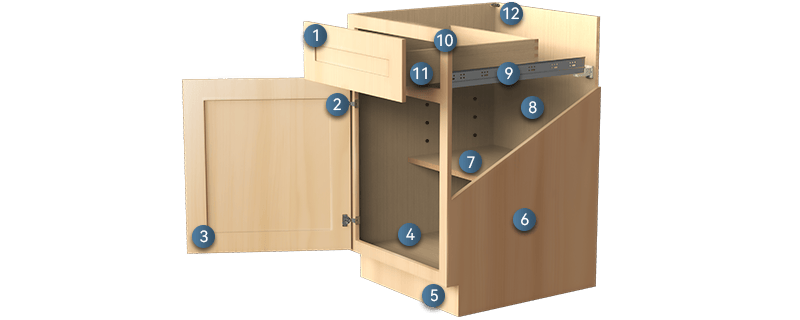
- Full-overlay Shaker door style
- Birch face frame and Birch door frame
- HDF door center panel
- 1/2-inch plywood cabinet box with matching exterior
- UV-coated natural plywood interior
- Concealed six-way adjustable soft-close hinges
- Undermount full-extension soft-close drawer glides
- Adjustable 3/4-inch half-depth shelves
- Plywood-reinforced back panel
- 9/16-inch dovetail drawer box
- 1/2-inch plywood toe kick on applicable base cabinets
- L-shaped corner brackets with 1/2-inch plywood reinforcement on applicable base cabinets
These specifications show why kitchen cabinet materials should be evaluated by component rather than described with a single material label. In this collection, the 1/2-inch plywood box forms the main cabinet structure, Birch is used for the face frame and door frame, and HDF is used for the Shaker door center panel. The shelves, drawer box, back panel, hinges, and glides each have separate construction specifications.
When comparing this collection with another cabinet line, compare equivalent components side by side, including box material and thickness, door construction, shelf thickness, drawer-box joinery, back-panel construction, hinges, glides, finish, and warranty. This provides a more useful comparison than relying only on broad descriptions such as “solid wood construction” or “plywood cabinets.”
Kitchen Cabinet Materials Buying Checklist
Before ordering kitchen cabinets, confirm these five points:
- Identify the material used for each component, including the cabinet box, back panels, shelves, face frame, doors, drawer fronts, and drawer boxes.
- Check panel thickness, shelf depth, back-panel construction, joinery, edge treatment, and hardware attachment rather than relying only on the material name.
- Separate the core material from the visible finish. Confirm whether paint, stain, laminate, thermofoil, or wood veneer is applied over solid wood, plywood, MDF, HDF, or particleboard.
- Review moisture protection, exposed edges, cleaning requirements, warranty limitations, and applicable TSCA Title VI compliance information for composite wood products.
- Compare the complete cabinet system, including construction, hinges, drawer glides, available sizes, delivery format, warranty coverage, and total project cost.
The best kitchen cabinet material is not one material used everywhere. A better cabinet system uses appropriate materials for each component and provides clear specifications for the box, doors, shelves, drawers, back panels, finish, and hardware.
Compare our RTA kitchen cabinets when you prefer flat-packed delivery and on-site assembly, or browse our pre-assembled kitchen cabinets when you want the cabinet boxes assembled before shipment. For broader planning guidance, continue with our 2026 RTA Cabinets Buying Guide.
Cabinet Material Buying FAQ
What are the most common materials used for kitchen cabinets?
The most common kitchen cabinet materials include solid wood, plywood, MDF, HDF, and particleboard. A single cabinet may combine several of these materials across the box, face frame, doors, shelves, back panels, and drawer components. Laminate, thermofoil, wood veneer, paint, and stain normally describe the visible surface or finish rather than the complete structural material.
What is the best material for kitchen cabinets?
There is no single material that is best for every cabinet component. Plywood is commonly used for cabinet boxes and shelves, solid wood may be used for face frames and door frames, and MDF or HDF may be suitable for painted doors and center panels. The best choice depends on where the material is used, its thickness and grade, the finish, moisture exposure, construction quality, and warranty.
Is plywood better than MDF for kitchen cabinets?
Not in every application. Plywood is commonly selected for structural components such as cabinet boxes and shelves, while MDF can provide a smooth and consistent surface for painted doors and decorative panels. Compare the specific component, panel thickness, product grade, edge protection, finish, moisture exposure, and construction rather than choosing by material name alone.
Are solid wood kitchen cabinets always better?
No. Solid wood can provide natural grain, strength, stain compatibility, and repairability, but it can also expand or contract as humidity changes. A well-constructed cabinet may combine solid wood with plywood, MDF, or HDF when each material is used appropriately for its component.
What material is best for painted cabinet doors?
MDF and HDF are often used for painted cabinet doors because their smooth, uniform surfaces can support consistent machining and finishing. Solid wood may also be painted, particularly for door frames, but natural movement and grain can affect the finished appearance. Always check the complete door construction, panel thickness, edge sealing, finish, and warranty.
How can I compare kitchen cabinet materials when shopping online?
Compare equivalent cabinet components across each collection. Check the box material and thickness, door and center-panel construction, shelves, drawer boxes, back panels, face frame, hinges, drawer glides, finish, available sizes, warranty coverage, and delivery format. Do not rely only on broad descriptions such as “all wood” or “plywood construction.”
Does RTA or pre-assembled delivery determine cabinet quality?
No. RTA and pre-assembled describe how the cabinet is delivered and when the cabinet box is assembled. Either format may use different materials, hardware, finishes, and construction methods, so compare equivalent product specifications rather than judging quality from the delivery format alone.
What should I check for kitchen cabinets installed near water?
Check the cabinet’s core materials, surface finish, edge sealing, installation clearances, and care requirements. Promptly repair plumbing leaks and avoid prolonged water exposure around sinks, dishwashers, toe kicks, and unfinished or damaged panel edges.


About author

Related posts

Some kitchen trends come and go, but Shaker cabinets have remained a staple in American kitchens for generations. Known for their simple recessed-panel doors and... Continue reading

This kitchen cabinet buying guide explains what to look for before you buy, including cabinet construction, materials, layout, storage, cost, finishes, and installation. Cabinets often... Continue reading
If you’re planning a kitchen upgrade, this is probably your first question:“How much should I really spend on cabinets?” And I’ll be honest with you—there’s... Continue reading

Bathroom color trends in 2026 are moving toward warmer, more natural palettes rather than stark white and cool gray alone. Light neutrals remain the safest... Continue reading

Last Updated: August 26, 2026 Kitchen cabinet cost in 2026 can range from about $50 to $900+ per linear foot for cabinets alone, while installed... Continue reading





Add comment