No products in the cart.
Return To Shop or
or  ,
,


Ultimate 2025 Kitchen Cabinet Guide: Types, Prices & Buying Tips
Kitchen cabinets are the core of a kitchen renovation — they determine the overall aesthetics and functionality of the space. Clarifying your preferred design style, material choices, and budget range is the first step in the purchasing process. This guide provides a comprehensive understanding of cabinet types, materials, prices, and design essentials to help you create your dream kitchen.
Table of Contents
Main Types
RTA (Ready-To-Assemble)
Pros: It is the most cost-effective option, easy to transport and move, suitable for DIY enthusiasts.
Cons: It requires time and effort to assemble, and generally has lower durability and stability.
If you want detailed answers about RTA cabinets and shipping, visit our RTA Cabinets FAQ Guide.
Pre-assembled
Pros: Moderately priced with relatively fast delivery. You can see the actual product quality at the building materials showroom. Because they are pre-assembled at the factory, the structure is more stable.
Cons: Limited size and style options; restricted to fixed standard dimensions and designs. Besides, it lacks uniqueness in design.
Semi-custom
Pros: It offers a certain degree of customization on the basis of standard cabinets (such as door styles, colors, size adjustments, and internal accessories), providing the best balance between cost-effectiveness, choice flexibility, and delivery speed.
Cons: Customization options are still limited to what the brand offers. Prices are higher than standard cabinets, and a certain production and delivery time is required.
Custom
Pros: It can not only fit any space size and layout, maximizing utilization, but also offer complete freedom in choosing materials, hardware, detailed designs, and functional accessories.
Cons: The most expensive option. Design and production cycles are very long (usually taking 4–12 weeks. Requires the full involvement of professional cabinet designers and demands a high budget and patience.
If you don’t have time or want to quickly get the key information, here is a concise version.
| Type | Price | Custom | Delivery Speed | Target Group |
| RTA | Lowest | None | Fastest | Budget-conscious, renters, DIY experts |
| Pre-assembled | Low | Low | Fast | Limited budget, value seekers, urgent need |
| Semi-Custom | High | Medium | Medium | Families seeking balance and some level of customization |
| Custom | Highest | Highest | Slow | Ample budget, special space requirements, pursuing ultimate design and quality |
Durability and Maintenance — Key Points of Common Materials
There are three main materials for kitchen cabinets, including Medium Density Fiberboard (MDF), veneer wood, and solid wood.
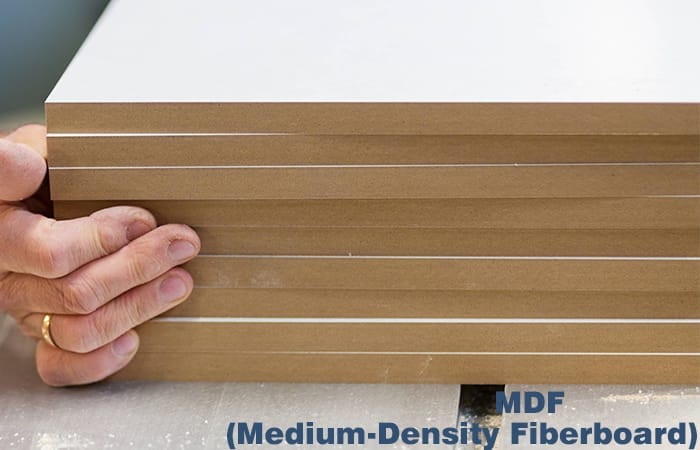
Medium Density Fiberboard (MDF)
Material: It is made by crushing wood scraps into fibers, bonding them with synthetic resin adhesives, and pressing the mixture at high temperature and pressure to form engineered boards. The surface is usually covered with a melamine film or PVC edging for moisture protection and decoration.
Typical lifespan: 10–15 years. Its lifespan is highly dependent on environmental humidity. In dry environments, it can last up to 15 years; however, if exposed to prolonged moisture (e.g., near sinks), the board will absorb water, swell, and crack at the edges, significantly shortening its lifespan.
Maintenance key points: Water and moisture resistance: This is the most important point. Any water spills should be wiped dry immediately.
High Density Fiberboard (HDF)
Material: Similar to MDF, but made with finer wood fibers and compressed at a much higher pressure, resulting in a denser and harder board. Surfaces are often laminated or veneered for aesthetics and moisture protection.
Typical lifespan: 15–20 years. Due to its density, HDF has better impact resistance, screw-holding strength, and stability compared to MDF. However, like MDF, it remains sensitive to prolonged moisture exposure.
Maintenance key points: Maintain a dry environment to avoid swelling. Wipe up spills promptly and use a damp (not wet) cloth for cleaning. Gentle cleaning products are recommended to protect the laminated or veneered finish.
Veneer Wood
Material: A very thin slice of precious solid wood (such as walnut or oak) is glued onto cheaper substrate boards like MDF, particle board, or plywood to provide a solid wood appearance and texture.
Typical lifespan: 15–20 years. It is more stable than solid wood and less prone to cracking or warping. Longevity depends mainly on the wear of the surface veneer and the quality of the substrate board. Since the veneer is very thin, severe scratches or peeling are difficult to repair.
Maintenance key points: Gentle care: Furniture wax or specialized cleaners can be used to maintain its shine and texture.
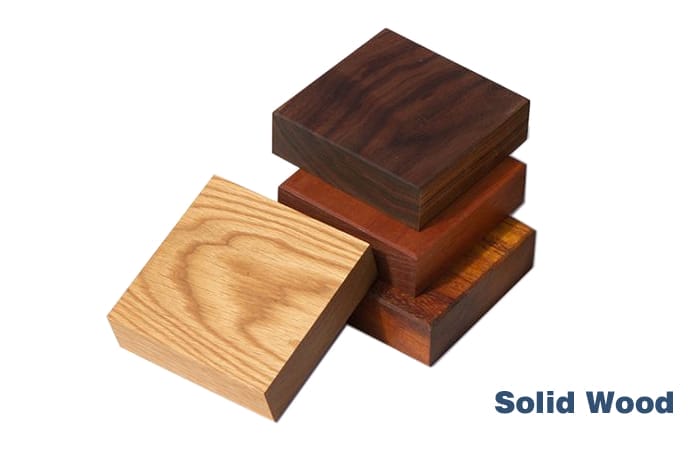
Solid Wood
Material: Made directly from natural wood such as oak, maple, cherry, walnut, etc.
Typical lifespan: Over 20 years. High-quality solid wood cabinets are very durable; even if surface scratches or wear appear, they can be renovated by sanding and refinishing or oiling to restore the original look.
Maintenance key points: Regular upkeep: Periodically (e.g., annually) apply furniture-grade wood wax or oils to replenish oils, prevent drying and cracking, and maintain aesthetics.
Whether you prefer HDF or solid wood, all our cabinets are crafted from premium materials to give you the best combination of quality and affordability. For a complete overview of kitchen cabinet styles, materials, and installation tips, check out our Ultimate Kitchen Cabinet Buying Guide (2025).
| Material | Definition | Advantages | Disadvantages |
| MDF | Engineered board of wood fibers and resin | Affordable, stable, smooth surface, good workability | Low moisture resistance, heavier, prone to sag, lower screw-holding |
| HDF | Engineered board made of compressed wood fibers at higher density than MDF | Denser, harder, smoother surface, better moisture and impact resistance | More expensive than MDF, still not as strong as solid wood, heavy |
| Veneer Wood | Layers of wood veneers glued with alternating grain | Strong, stable, good load-bearing | Less smooth surface than MDF, moderate cost |
| Solid Wood | Natural wood sawn from logs | High strength, durable, natural beauty | Expensive, variable, sensitive to moisture, needs maintenanc |
Price
The average price of kitchen cabinets ranges from $1,500 to $30,000+, depending on the cabinet’s degree of customization and size. Here’s a breakdown of what to expect.
| Types | Total price | Per linear foot price |
| RTA | $1,500–$3,000 | $100–$300 |
| Pre-assembled | $2,000–$5,000 | $150–$400 |
| Semi-Custom | $3,000–$12,000 | $400–$650 |
| Custom | $5,000–$30,000+ | $500–$1,200 |
However, prices also need to be divided according to regions, so the specific situation still needs to be analyzed in detail. Let’s take RaraRTACabinets as an example. If you order RTA cabinets there, the shipping price is as below.
| Order total (Unit: $) | Shipping price (Unit: $) |
| Up-99.99 | 19 |
| 100-199.99 | 39 |
| 200-699.99 | 59 |
| 700-999.99 | 169 |
| 1000-1599.99 | 249 |
| 1600-1999.99 | 299 |
| 2000-2499.99 | 359 |
| Over 2500 | free |
As for the Pre-Assemble cabinets in RaraRTACabinets, shipping costs $299 if the order total is under $2500. If the order total exceeds $2500, shipping is free.
Installation and Delivery Considerations
Since there are various types of cabinets, after purchase, we need to pay attention to the warehouse shipping time, whether installation is included, and on-site measurements. We will use RaraRTACabinets as an example.
If you place your RTA cabinet order before 12 pm ET, all quick-ship eligible items will be shipped within 3 weekdays. Orders placed after 12 pm ET will be processed starting the next business day. This doesn’t include assembled cabinets, backordered items, shipping loss or damage, claim items, severe weather, holidays, carrier restrictions, or other issues beyond RaraRTACabinets’ control.
All assembled cabinets are made-to-order and usually take up to 21 weekdays to get ready and be shipped out. Also, due to the method of shipping and delivery, delivery times might sometimes be longer depending on where you are and the carrier schedule.
However, because this store is a cabinet distributor, it does not offer installation services.
Design and Storage Recommendations
There are three main types of cabinets: Lazy Susan, Pull-Outs, and Deep Drawers. Each has its unique purpose and is suitable for storing different items. Here’s a brief overview.
Lazy Susan
Purpose: Ideal for corner cabinets, the Lazy Susan allows you to easily access items stored in the corners without having to reach or bend.
Best for: Storing small items like bottles of condiments, canned goods, or cleaning supplies, especially those you use frequently but don’t want to lose track of.
Pull-Outs
Purpose: Pull-out cabinets make it easier to access deep cabinets by sliding out the storage space. They are typically installed in the lower cabinets.
Best for: Storing long items such as baking trays, pots and pans, or cleaning tools. They’re also great for organizing miscellaneous kitchen gadgets.
Deep Drawers
Purpose: Deep drawers are designed to store larger, bulkier items, providing more capacity than standard drawers. They allow easy access to deeper storage areas.
Best for: Storing large pots, pans, lids, utensils, or food storage containers that are too big for regular drawers.
Each of these cabinet types has its advantages, and you can choose the one that best fits your kitchen’s needs for more efficient space utilization.
| Name | Usage | Suitable for |
| Lazy Susan | for use in base blind corner cabinets | Little bottles and jars |
| Pull-outs | adjusted from 10 inches to 20 inches in width, perfectly fitting various cabinet sizes. | Tableware |
| Deep Drawers | Unlock the full potential of your kitchen storage | Cookware |
Conclusions
Here is the introduction and pre-purchase analysis of kitchen cabinets. I believe that after reading the above, you will have a better understanding of your preferences and be able to choose the right type for yourself.
Finally, I would like to recommend a few popular products to you. Take a look and see if any of them catch your interest.
| Name | Characteristics |
| Open Shelving | It gives people a light and breathable feeling, which is especially beneficial in smaller kitchens. |
| Color Customization | Many people will create unique styles and colors for their kitchens, which reflects their aesthetics and personality. |
| Inset cabinet | It becomes more popular because of its sophisticated technology and timeless elegance. It emphasizes meticulous construction and attention to detail. |


About author

Related posts
When people shop for new cabinet doors, they often focus on color, style, or finish first. That makes sense. But in real home projects, the... Continue reading
Painting bathroom cabinets is not the same as painting a dresser or a living room shelf. A bathroom is a humid space, which means the... Continue reading
Floating cabinets are beautiful. They make a space feel lighter, cleaner, and more refined. No bulky legs, no visual clutter — just a clean, modern... Continue reading
Cabinets take up a large part of any kitchen, bathroom, or laundry room. When the color no longer feels right, the whole space can start... Continue reading
Installing an undermount sink and cabinets might seem straightforward, but the truth is, proper installation is key to keeping your kitchen safe and functional for... Continue reading





Add comment