No products in the cart.
Return To Shop or
or  ,
,


Why Choose a U-Shaped Kitchen? Layout, Dimensions & Cabinet Tips
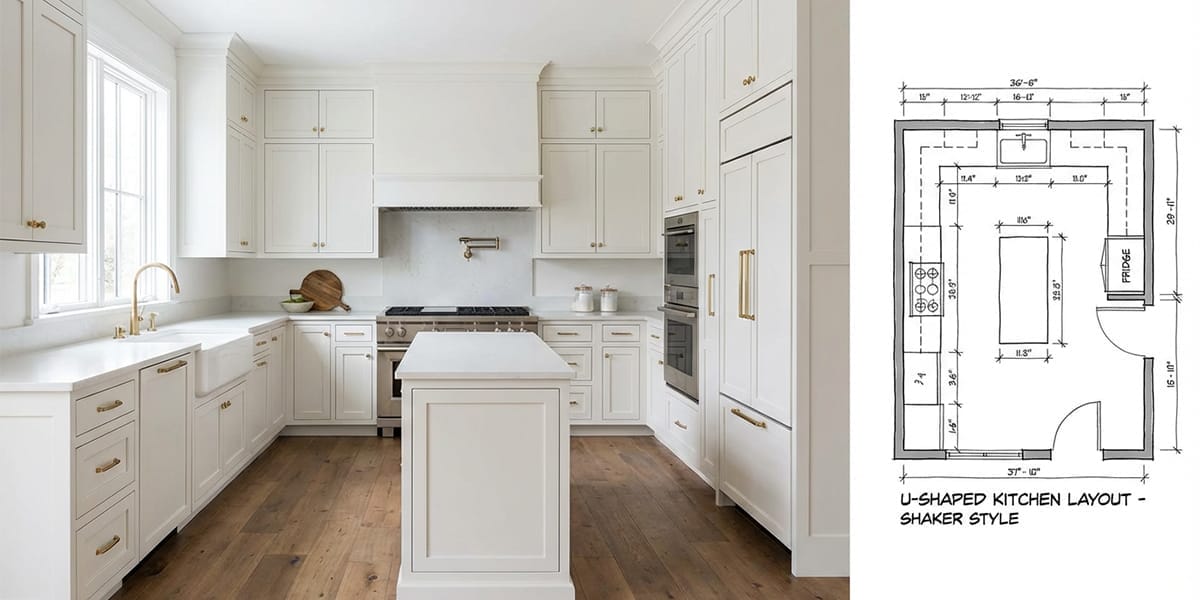
A U-shaped kitchen turns three walls into an efficient, ergonomic workspace. For many home cooks it’s the goldilocks layout: compact enough to minimize steps, but roomy enough for generous storage and multiple work zones. This guide explains the real advantages (and the tradeoffs), provides practical sizing and layout recommendations, and shows how to choose cabinets and corner solutions to get the most from a U-shaped kitchen.
Table of Contents
Why people choose a U-shaped kitchen
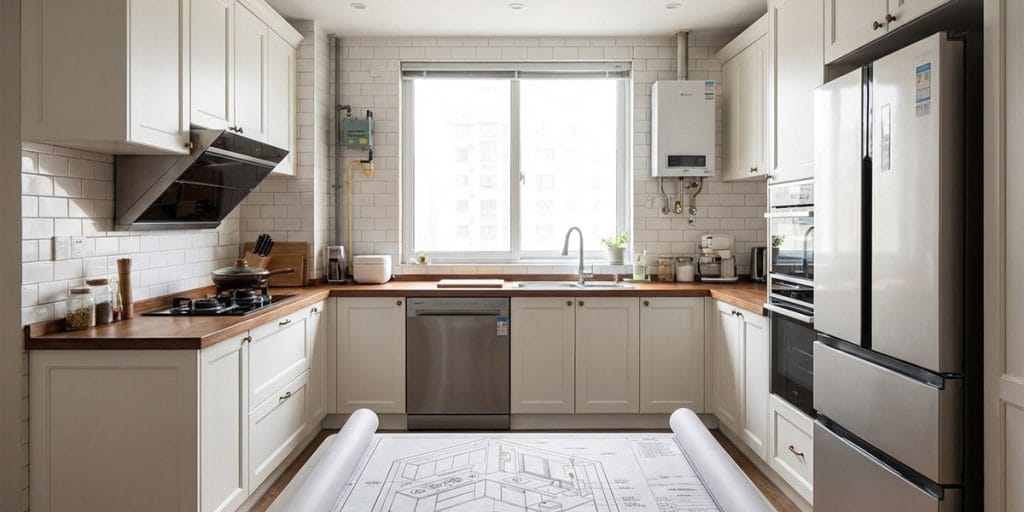
- Efficient workflow. Prep, wash, cook and plate can be arranged in a natural sequence with minimal walking.
- Maximum storage. Three runs of cabinets (upper and lower) give abundant storage and flexible drawer configurations.
- Fits odd room shapes. A U-layout adapts to many footprints better than single-line or simple L plans.
- Good for single cooks and adaptable for two. With the right aisle widths it supports one person working intensively or two people working together.
Main drawbacks (and quick fixes)
- Corner “blind spots.” Traditional corners can be hard to access — fixable with pull-out corner units, lazy susans, or dedicated corner drawers.
- Potentially tight aisles. If the center aisle is too narrow it feels cramped; design for appropriate clearance.
- Lighting & ventilation demand. More wall area may need careful lighting and hood planning.
Practical dimensions & ergonomics
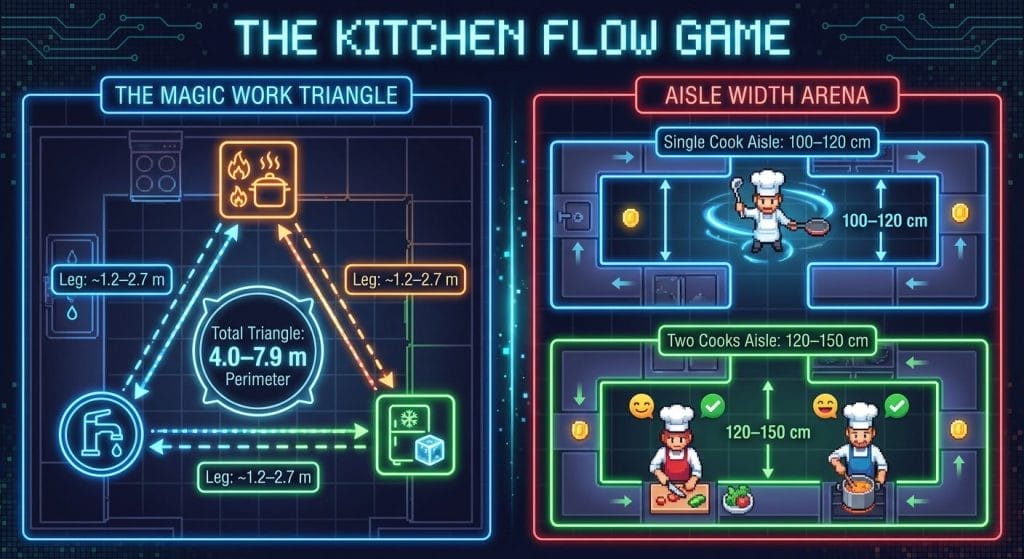
Use these as starting points — adjust for the primary cook’s height and your actual space.
- Countertop height: 85–95 cm (33½–37½ in). Typical default ~90 cm (35¼ in). Choose by elbow height minus 5–10 cm.
- Wall cabinet bottom height from floor: 145–150 cm (57–59 in) (i.e., ~45–60 cm / 18–24 in above a 90 cm counter).
- Wall cabinet height: 50–80 cm (20–32 in) depending on ceiling height and storage needs.
- Center aisle width (U-shape):
- Single cook: 100–120 cm (39–47 in).
- Two cooks comfortably: 120–150 cm (47–59 in).
- Sink size (typical): 60–80 cm wide, 20–25 cm deep (24–32 in wide, 8–10 in deep) — pick larger for big pans/pots.
- Work triangle (sink–stove–fridge): Each leg ≈ 1.2–2.7 m (4–9 ft); total triangle perimeter 4.0–7.9 m (13–26 ft).
Workflow & placement tips
- Sequence your zones. Arrange “store → prep → wash → cook → plate” in a smooth path. In a U, the sink often sits on the center run with fridge and cooktop on the sides.
- Keep frequently used items reachable. Place utensils, cutting boards and oils within arm’s reach of prep zones.
- Avoid blocking oven doors and fridge doors with opposite cabinets. Check swing clearances during planning.
Kitchen Corner Solutions Showdown
| Solution | Pros | Cons | Key Feature |
|---|---|---|---|
| Lazy Susan (turntable) | Inexpensive, good for lightweight items | Can waste depth | Classic turntable design |
| Pull-out corner unit | Shelves pull fully out, great for heavy items | – | Converts the corner into fully accessible shelves |
| Bi-fold or magic corner | High usability, brings back both inner shelves | Higher cost | Clever hardware that brings shelves to you |
| Corner drawers (stacked) | Excellent ergonomics, most convenient | Needs custom design, highest cost | Converts the corner into a series of drawers |
How to choose cabinets for a U-shaped kitchen
- Material & core: HDF or good-grade plywood for better dimensional stability; avoid cheap particleboard near sinks or high-humidity areas.
- Thickness: Base cabinets commonly 15–18 mm (⅝–¾ in); thicker panels for heavy loads.
- Edge banding & sealing: Insist on factory-applied, well-bonded edge banding and sealed backs to minimize moisture ingress.
- Drawer systems: Full-extension, soft-close drawer runners increase usable space and longevity.
- Hardware: Use quality stainless hardware — 304 for most kitchens, 316 for coastal/salty environments.
- Custom vs modular: Modular units speed installation and cost less; custom allows optimized corner solutions and unique fit.
Lighting, ventilation & finishing touches
- Task lighting under wall cabinets is essential for a U-shape — long continuous strips or multiple puck lights work well.
- Range hood placement: Install directly above the cooktop with adequate clearance to capture steam and smoke.
- Backsplash & water control: A continuous backsplash and well-sealed counter-to-wall joint minimize water damage to cabinets.
Contractor checklist
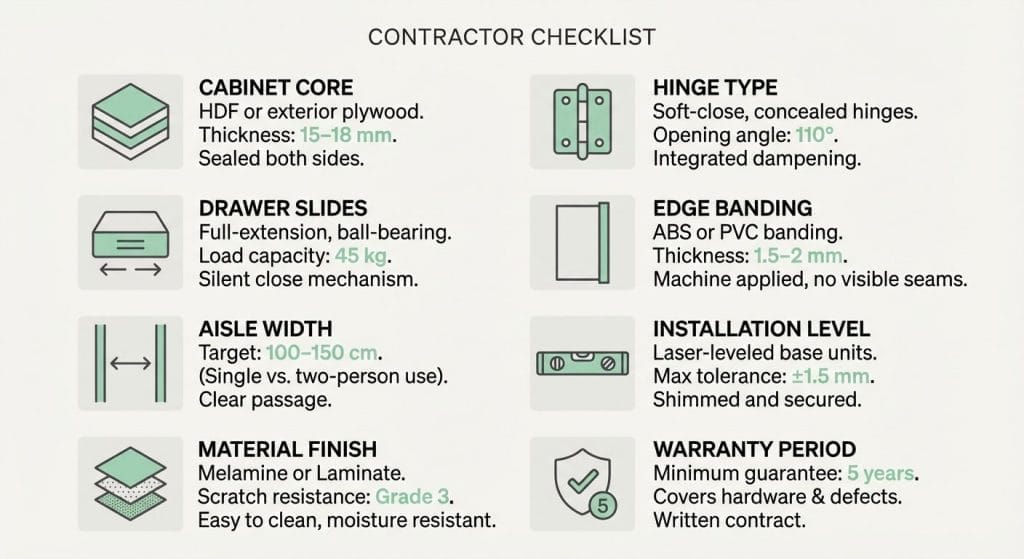
- Cabinet core: HDF or exterior-grade plywood, sealed both sides; thickness 15–18 mm (⅝–¾ in).
- Edge banding: 0.5–1.5 mm thick, hot-melt/PU adhesive, corners fully sealed.
- Hardware: stainless hinges & slides; specify 316 for coastal homes.
- Countertop: specify material (quartz / stainless / solid surface) and include backsplash water-blocking strip.
- Sink: undermount recommended; specify cutout and silicone sealing.
- Aisle width: indicate center aisle target (100–150 cm / 39–59 in depending on single vs two-person use).
- Corner solution: choose (Lazy Susan / pull-out corner / magic corner / corner drawers).
- Lighting: specify under-cabinet task lighting runs and general ceiling luminaires.
FAQ
Is a U-shaped kitchen good for small spaces?
Yes — with a compact center aisle it’s very efficient, but ensure sufficient clearance for comfort.
Can two people cook in a U kitchen?
Yes if the center aisle is ≥120 cm (≈47 in). Wider aisles (120–150 cm) allow comfortable two-person workflows.
What’s the best corner storage?
Depends on budget and items. Pull-out corner units or magic corners are best for accessibility; lazy susans are cheaper.
Final takeaway
A U-shaped kitchen delivers top-tier efficiency, storage and adaptability when designed with the right clearances, corner solutions, and cabinet choices.


Related posts

If you’re planning a laundry setup on your balcony, one question matters more than anything else: What kind of cabinet will actually last—and not turn... Continue reading
If you’re planning a kitchen upgrade, installing a new sink might seem like a simple task. I’ve had many homeowners tell me,“It looks easy enough—I’ll... Continue reading
If your kitchen feels tight, cluttered, or just hard to work in—you’re not alone. I’ve worked with plenty of homeowners across the U.S., and honestly,... Continue reading
When planning a bathroom remodel, many homeowners focus on tile, lighting, or paint colors. But after working with bathroom designs for many years, I’ve learned... Continue reading
A wall mounted wine rack is more than just a storage solution. In many homes, it becomes a subtle design feature that adds personality and... Continue reading





Add comment