No products in the cart.
Return To Shop


RTA vs Pre-Assembled Cabinets: Which Is Better for Your Kitchen?
Last Updated: September 2, 2026
Choosing between RTA and pre-assembled kitchen cabinets involves more than comparing the prices on two product pages. The real question is how much you will spend on cabinet assembly, delivery, and installation before your kitchen is ready to use.
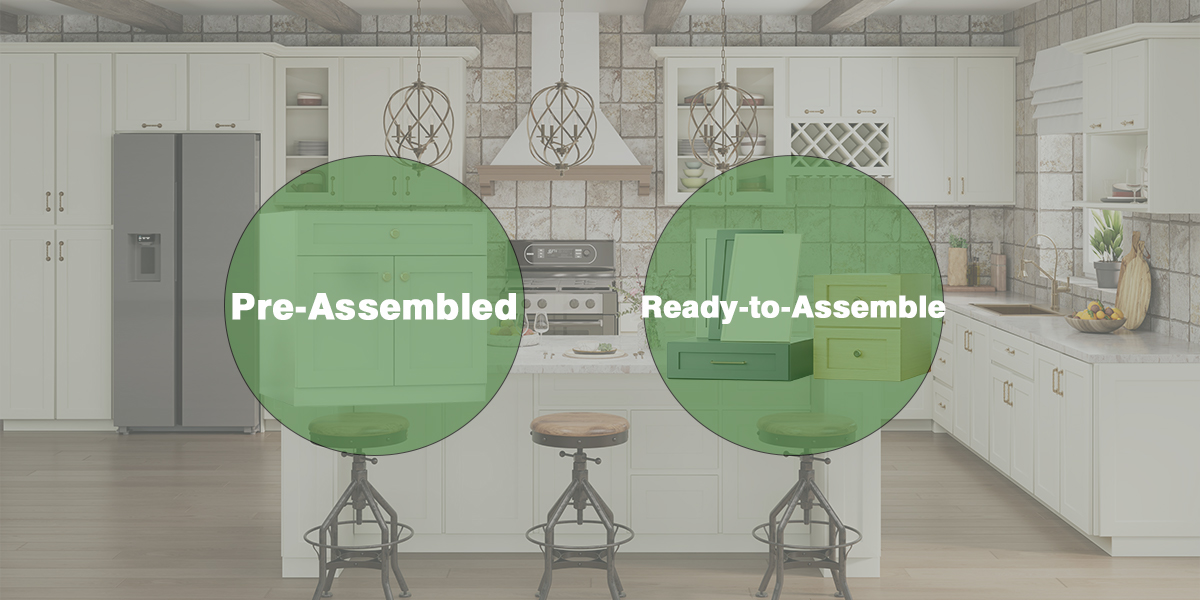
RTA kitchen cabinets arrive as flat-packed components that need to be assembled before installation. Pre-assembled kitchen cabinets arrive with the cabinet boxes already built, eliminating that step. However, both options still require proper on-site installation, including leveling, fastening, fitting panels, and making final adjustments.
RTA cabinets can offer better value when you have the time and resources to handle assembly at a reasonable cost. Pre-assembled cabinets may be more practical when professional assembly charges would reduce those savings or when your renovation schedule is tight. Neither option is automatically better in quality. This guide compares the total costs, construction, assembly work, shipping considerations, and real-world buying scenarios to help you decide which format is right for your kitchen.
Table of Contents
RTA vs Pre-Assembled Cabinets: Side-by-Side Comparison
The biggest difference between RTA and pre-assembled cabinets is not necessarily their appearance or construction quality. It is how much work is completed before the cabinets reach your home and how that affects the overall project.
A fair comparison should consider the complete cost, assembly requirements, installation schedule, delivery access, and cabinet specifications. The table below highlights what matters most before you order.
| Comparison | RTA Cabinets | Pre-Assembled Cabinets | What to Check Before Buying |
|---|---|---|---|
| Cabinet Price | Often lower upfront for comparable specifications. | Usually includes cabinet-box assembly costs. | Compare identical layouts, materials, and hardware. |
| Assembly Labor | Requires DIY time or paid assembly. | Cabinet boxes arrive assembled. | Ask if assembly costs extra. |
| Total Project Cost | Depends on assembly, delivery, and installation charges. | Higher upfront cost may be offset by labor savings. | Compare final delivered and installed costs. |
| Project Schedule | Assembly is required before installation. | Installation can begin after delivery and inspection. | Confirm lead times and installation dates. |
| Shipping and Access | Flat-packed cartons simplify narrow access. | Larger boxes require more handling space. | Measure doors, stairs, and hallways. |
| Storage and Workspace | Needs space for assembling cabinet parts. | Needs storage for larger assembled units. | Check available space before delivery. |
| Construction Quality | Depends on materials and assembly accuracy. | Depends on materials and factory assembly. | Review construction specifications and hardware. |
| Best Fit | Projects with manageable assembly costs. | Projects prioritizing convenience and less on-site preparation. | Choose based on budget, access, and schedule. |
The key takeaway: RTA cabinets are often the better financial choice when the price difference is large enough to cover the time or labor required for assembly. Pre-assembled cabinets may offer better overall value when assembly charges, limited workspace, or scheduling constraints reduce those savings.
Before choosing either option, compare cabinets with equivalent construction specifications. A plywood cabinet box, drawer hardware, door finish, and warranty should be evaluated separately from whether the cabinet arrives assembled or flat-packed.

What Actually Arrives With RTA and Pre-Assembled Cabinets?
The difference between RTA and pre-assembled cabinets becomes clearer when you look at what arrives at your door. Both formats provide the components needed for the selected cabinet configuration, but the amount of work completed before delivery is different.
What Comes With RTA Kitchen Cabinets?
Ready-to-assemble cabinets are shipped in flat-packed cartons containing the components needed to build each cabinet. Depending on the model and collection, these may include:
- Pre-cut and pre-drilled cabinet-box panels
- Face frames where applicable
- Cabinet doors or drawer fronts
- Shelves and drawer components
- Hinges, drawer slides, and assembly hardware
- Collection-specific assembly instructions
The cabinet-box panels must be joined and secured before installation. Some components, such as doors, drawers, and adjustable hardware, may require additional fitting during or after assembly.
Before starting, organize the parts by cabinet model and check that the supplied components match the packing information. This is especially useful for kitchens with multiple cabinet sizes and drawer configurations.

What Comes With Pre-Assembled Kitchen Cabinets?
Pre-assembled cabinets arrive with the cabinet boxes already built. The panels are joined and squared before shipment, so the installer does not need to construct the boxes from individual parts.
Depending on the collection, doors, drawers, shelves, and hardware may arrive installed, partially fitted, or packaged separately for protection during transportation.
Pre-assembled does not mean installation-ready without any preparation. The cabinets still need to be inspected, positioned, leveled, secured, and adjusted at the job site.
What Should You Check When Your Cabinets Arrive?
Regardless of which format you choose, inspect the shipment before scheduling installation.
Confirm that the cabinet models and quantities match your order. Check for visible shipping damage, verify that required components and hardware are included, and document any issues according to the supplier’s delivery and claims procedures.
For RTA cabinets, complete the component check before assembly. For pre-assembled cabinets, inspect the cabinet boxes, doors, drawers, and finishes before moving them into their final positions.
This preparation can help prevent missing parts or shipping damage from interrupting the installation schedule.
RTA vs Pre-Assembled Cabinets: Assembly, Installation, and Project Timing
The difference between RTA and pre-assembled cabinets becomes especially important once your renovation moves from ordering materials to scheduling installation. Both can produce a finished kitchen, but the work leading up to that point is different.
Understanding these steps helps you plan labor, avoid unnecessary delays, and make sure your installer knows exactly what to expect.
What Happens Before Cabinet Installation?
With RTA cabinets, the cabinet boxes must be assembled before they can be installed. This means setting aside time and workspace to build each unit, secure its connections, and check that the cabinet is square.
A standard wall cabinet may be relatively straightforward to assemble, while a drawer base or specialty cabinet can involve additional components and adjustments. The actual work depends on the cabinet design and assembly instructions.
For a larger kitchen, assembly needs to be planned as a separate stage rather than something to squeeze into installation day.
Pre-assembled cabinets eliminate this box-building stage. The cabinet boxes are assembled before shipping, allowing your installer to focus on the remaining on-site work after the shipment has been received and inspected.
If your contractor is handling the installation, confirm whether they are willing to assemble RTA cabinets and whether that service is included in their quote.
What Work Is Still Required on Site?
One common misunderstanding is that pre-assembled cabinets are ready to use as soon as they arrive.
In reality, both cabinet formats require careful on-site installation.
The installer must check the layout against the actual room dimensions, account for uneven walls or floors, and position the cabinets so the entire run is properly aligned.
This usually involves:
- Establishing level reference lines and checking cabinet placement
- Shimming and leveling the cabinets as needed
- Connecting adjacent cabinet boxes
- Securing cabinets to appropriate structural supports
- Fitting fillers, finished panels, toe kicks, and trim
- Making final adjustments to doors, drawers, and hardware
- Coordinating cabinet installation with countertop measurements and other trades
With RTA cabinets, these steps begin after the boxes have been assembled. With pre-assembled cabinets, they can begin once the delivered units are inspected and the installation area is ready.
The installation requirements do not disappear simply because the cabinet boxes were assembled at the factory.
Delivery Access Can Change Your Choice
Think about how the cabinets will physically reach your kitchen.
In an open-plan home with wide entryways, moving assembled cabinet boxes into place may be straightforward. In a home with narrow hallways, steep stairs, or tight turns, the size of the delivered units becomes much more important.
RTA cabinets are delivered in separate cartons, which can make them easier to move through restricted spaces before assembly.
Pre-assembled cabinets require enough clearance to maneuver the largest completed boxes. A cabinet might fit through a doorway but still be difficult to turn around a corner or carry up a staircase.
Before ordering, measure the full delivery route, including exterior entryways, interior doors, hallways, stairs, elevators, and turning areas.
Also consider where the shipment will be stored. RTA cabinets require space for both cartons and assembly work, while pre-assembled cabinets need protected space for larger finished units.

How Does Each Option Affect Your Renovation Schedule?
Pre-assembled cabinets save the time required for cabinet-box assembly after delivery, but they do not automatically guarantee a faster renovation.
The actual schedule depends on product availability, order processing, freight delivery, installation readiness, and any additional work needed on site.
For an RTA project, the sequence should include delivery, component inspection, cabinet assembly, completed-box inspection, and installation.
For a pre-assembled project, the sequence is shorter after delivery, but you still need time to receive the shipment, inspect the cabinet boxes, and resolve any issues before the installation team begins.
Discuss these three milestones with your supplier and installer:
- Expected delivery: When will all required cabinet components or assembled units arrive?
- Installation readiness: When will the cabinets and the room be ready for the installer?
- Installation completion: When should cabinet installation be finished so countertop work and other trades can proceed?
If you have a fixed renovation deadline, confirm these dates before placing the order rather than assuming one cabinet format will arrive or install faster.
The practical takeaway: RTA cabinets give you more flexibility in handling and assembling the boxes, while pre-assembled cabinets remove a preparation step. Which advantage matters more depends on the space, labor, and scheduling conditions of your project.
RTA vs Pre-Assembled Cabinets: How Much Can You Actually Save?
RTA kitchen cabinets often have a lower initial purchase price, but the difference can shrink once assembly labor, delivery, and installation are included. A fair comparison looks at the completed cabinet project rather than the cabinet boxes alone.
For example, a homeowner comparing RTA and pre-assembled cabinets for the same kitchen layout should request matching cabinet quantities, sizes, construction materials, door styles, drawer hardware, and finishing accessories. This prevents differences in product specifications from being mistaken for savings on assembly.
A Sample RTA vs Pre-Assembled Cabinet Cost Comparison
Consider a kitchen where both options use equivalent cabinet specifications and the same layout. The RTA package costs less upfront, but the homeowner must pay a contractor to assemble the cabinet boxes.
The following example shows how those additional charges affect the final cost.
Illustrative example only. These are hypothetical figures for explaining the calculation, not actual RARA prices, customer quotes, or verified market averages.
| Cost Item | RTA Cabinets | Pre-Assembled Cabinets |
|---|---|---|
| Cabinet Package | $4,000 | $5,000 |
| Cabinet Box Assembly | $750 | Included |
| Delivery and Handling | $250 | $450 |
| On-Site Installation | $2,000 | $2,000 |
| Fillers and Finished Panels | $450 | $450 |
| Estimated Total | $7,450 | $7,900 |
What Does This Cost Difference Tell You?
In this example, the RTA cabinet package starts at $4,000, while the pre-assembled package costs $5,000. That is a $1,000 difference before adding other project expenses.
After including cabinet assembly, delivery, installation, and finishing components, the estimated totals become $7,450 for RTA and $7,900 for pre-assembled cabinets.
The actual savings in this hypothetical scenario are $450, not $1,000.
This distinction matters because the lowest cabinet price does not always produce the lowest completed project cost.
When Do RTA Cabinets Stop Saving Money?
In the same example, increasing RTA cabinet-box assembly labor from $750 to $1,200 would bring the two estimated totals to the same amount.
At that point, the homeowner would no longer save money by choosing RTA, assuming all other costs remain unchanged.
However, if the homeowner can assemble the cabinets without paying a contractor, the direct cash savings could be greater. The tradeoff is the time, tools, workspace, and attention required to complete assembly correctly.
This is why it is worth requesting an assembly quote before making a purchase decision.
How to Compare Your Own Cabinet Costs
Start with the same cabinet layout and specifications for both options. Then add the costs that apply to your project:
- Cabinet package price
- Cabinet-box assembly labor, if required
- Shipping, delivery, and handling charges
- On-site cabinet installation
- Fillers, finished panels, toe kicks, and required accessories
- Applicable sales tax and any other project-specific charges
Avoid counting the same service twice if it is already included in the cabinet or installation quote.
You can use our kitchen cabinet cost estimator to establish a preliminary budget, then review our kitchen cabinet quote comparison guide to check what is included before ordering.
The better value is not always the option with the lower cabinet-box price. It is the option that provides the specifications you need at a reasonable completed project cost.
RTA vs Pre-Assembled Cabinets: Is There a Difference in Quality?
One of the biggest concerns when comparing RTA and pre-assembled kitchen cabinets is whether assembling the cabinets yourself means sacrificing durability.
The short answer is no. A properly assembled RTA cabinet can be just as durable as a comparable pre-assembled cabinet. What matters is how the cabinet is constructed, the quality of its components, and whether it is assembled and installed correctly.
However, not every cabinet collection uses the same materials or construction methods. To make a fair comparison, you need to look beyond the delivery format.
1. Cabinet Box Construction: Compare the Actual Specifications
Start with the cabinet box itself.
Cabinets may use plywood, MDF, particleboard, or combinations of engineered materials. Their strength and performance also depend on panel thickness, joint design, back-panel support, and how the cabinet is secured during installation.
For example, an RTA cabinet with plywood box construction should not automatically be considered inferior to a pre-assembled cabinet simply because it arrives in pieces.
Likewise, a pre-assembled cabinet is not necessarily better constructed just because its panels were joined at the factory.
When reviewing two cabinet collections, compare:
- Cabinet-box material and panel thickness
- Corner joints and connection methods
- Back-panel construction and support
- Shelf material and weight capacity, where specified
- Face-frame or frameless construction
- Manufacturer warranty and applicable exclusions
The goal is to determine whether you are comparing cabinets with similar specifications, not simply different assembly formats.
2. Doors, Drawers, and Hardware: Look Beyond the Cabinet Box
Cabinet quality also depends on the components you interact with every day.
Two kitchen cabinets may have similar box construction but use very different drawer slides, hinges, door materials, or finishes.
For example, one collection may include soft-close concealed hinges and full-extension drawer slides, while another uses different hardware specifications.
These differences can affect how the cabinets operate and what features you receive for the price, regardless of whether they are RTA or pre-assembled.
Pay particular attention to door construction, drawer-box joinery, drawer slide functionality, hinge adjustability, and finish specifications.
Do not assume that two cabinets with the same Shaker door style offer the same construction quality. Check the specifications of the complete cabinet system.
3. Does Factory Assembly Make Cabinets More Reliable?
Factory assembly can provide consistency because the cabinet boxes are built before shipment using the manufacturer’s assembly process.
For buyers who have limited assembly experience, this eliminates the possibility of making mistakes while constructing the cabinet boxes themselves.
However, factory assembly does not prevent all problems. Pre-assembled cabinets can still experience shipping damage, hardware misalignment, or installation-related issues.
RTA cabinets place more responsibility on the person performing assembly. Panels need to be joined correctly, connections secured, and cabinet boxes checked for square before installation.
When those steps are completed correctly, the delivery format itself does not establish a durability disadvantage.
4. How to Make a Fair Quality Comparison
Consider two cabinet packages for the same kitchen.
Option A: RTA cabinets with plywood cabinet boxes, the specified door construction, and soft-close hinges and drawer slides.
Option B: Pre-assembled cabinets with the same cabinet-box materials, comparable doors, and equivalent hardware.
If the underlying specifications are equivalent, the primary difference may be where the cabinet boxes are assembled rather than the quality of the finished cabinets.
But if one package uses different materials, hardware, or construction methods, those differences should be evaluated separately from assembly costs.
Before ordering, request the cabinet specifications for both options and confirm exactly which components and features are included.
For a more detailed inspection checklist, see our guide to RTA cabinet quality.
The bottom line: Choose cabinet quality based on construction specifications, hardware, finish, warranty, and assembly accuracy—not on whether the cabinets arrive flat-packed or already assembled.

Which Is Better for Your Kitchen? 4 Real-World Buying Scenarios
The right choice between RTA and pre-assembled cabinets often comes down to how your renovation will actually be completed.
Two homeowners can choose cabinets with identical materials and hardware but have very different experiences depending on who handles assembly, how the cabinets are delivered, and when installation needs to begin.
Here are four common situations where one format may make more sense than the other.
Scenario 1: You’re Remodeling Your Kitchen Yourself
Best fit: RTA cabinets, if you have the time and tools for assembly.
Suppose you’re renovating your kitchen over several weekends. You have a garage or another clean workspace, and you’re comfortable following cabinet assembly instructions.
In this situation, RTA cabinets can be an attractive option. Instead of paying someone to assemble every cabinet box, you can complete the work yourself before installation begins.
You can also assemble the cabinets in stages, starting with simpler wall and base units before moving on to drawer bases or specialty configurations.
However, DIY assembly requires more than basic familiarity with tools. You need to follow the manufacturer’s instructions, check that each completed box is square, and keep the components organized.
Consider pre-assembled instead if: You don’t have a suitable workspace, prefer not to handle cabinet assembly, or would rather spend your renovation time on other tasks.
Scenario 2: You’re Hiring a Contractor for the Entire Kitchen
Best fit: Compare both options using your contractor’s complete labor quote.
Imagine your contractor is responsible for removing the old cabinets, preparing the room, installing the new cabinetry, and coordinating the countertop installation.
In this situation, buying RTA cabinets does not necessarily mean you’ll save money.
Some contractors regularly work with RTA cabinets and can assemble them efficiently. Others may charge separately for box assembly or prefer cabinets that arrive already built.
Ask your contractor to provide a quote that clearly separates cabinet-box assembly from on-site installation.
If the additional assembly cost is small compared with the difference in cabinet prices, RTA may still be the better value.
If assembly labor absorbs most of the savings, pre-assembled cabinets may offer a simpler process for a similar completed cost.
Before deciding: Confirm whether the contractor’s estimate includes assembly, cabinet installation, fillers, finished panels, toe kicks, and final hardware adjustments.
Scenario 3: Your Kitchen Has Narrow Stairs or Difficult Access
Best fit: RTA cabinets may be more convenient to bring into the kitchen.
Consider an upstairs kitchen in a townhouse where the delivery route includes a narrow staircase, several turns, and limited space to maneuver.
Moving a fully assembled cabinet box through these areas can be challenging, especially with larger base or pantry cabinets.
RTA cabinets arrive in separate cartons, allowing the components to be moved into the kitchen before the boxes are assembled.
This can make handling more manageable when access is restricted.
However, the advantage depends on having enough space to assemble and store the cabinets once the cartons are inside.
Pre-assembled cabinets may still work perfectly well if the delivery route has sufficient clearance.
Before deciding: Measure door openings, hallway widths, staircase turns, and the largest cabinet dimensions. Don’t assume that a cabinet will fit simply because its width is smaller than the doorway.
Scenario 4: Your Kitchen Renovation Has a Fixed Completion Date
Best fit: Pre-assembled cabinets may reduce on-site preparation time, provided delivery is confirmed.
Suppose your countertop installer has already been scheduled, and your kitchen cabinets need to be installed before the countertop template appointment.
With RTA cabinets, the boxes must be assembled and inspected before installation can begin. This creates an additional task that needs to be completed on schedule.
Pre-assembled cabinets eliminate that particular step, allowing the installation team to begin working with completed cabinet boxes after delivery and inspection.
This may be helpful when several trades are working within a limited renovation window.
However, pre-assembled cabinets are not automatically delivered faster. Product availability, order processing, freight transportation, and potential shipping damage can all affect the schedule.
A readily available RTA collection may be a more practical choice than a pre-assembled collection with a longer lead time.
Before deciding: Confirm product availability, estimated delivery dates, and the installer’s schedule. Leave time to inspect the shipment and address any missing or damaged components.
So, Which Cabinet Format Should You Choose?
If you’re still undecided, consider these three questions:
1. Who will assemble the cabinets?
If you can handle assembly yourself or have affordable help, RTA cabinets may provide better value. If assembly would require expensive additional labor, compare the total installed price before deciding.
2. Can the cabinets reach your kitchen easily?
Flat-packed RTA cabinets can simplify difficult delivery routes. Pre-assembled cabinets are more convenient when larger boxes can be received, stored, and moved into position without problems.
3. How important is your renovation schedule?
If you have sufficient time for cabinet assembly, RTA can be a practical choice. If reducing on-site preparation is important, pre-assembled cabinets deserve consideration, provided the delivery schedule works for your project.
Ultimately, neither format is universally better. The most suitable option is the one that meets your construction requirements while fitting your budget, workspace, labor arrangements, and installation timeline.
Once you’ve decided which format suits your kitchen, the next step is to compare the actual cabinet collections, door styles, finishes, dimensions, and available configurations.
Find the Right Kitchen Cabinet Collection for Your Project
Ready to explore your options? RARA offers both ready-to-assemble and pre-assembled kitchen cabinets, with Shaker and European-style collections available in a range of finishes and configurations. Compare cabinet dimensions, construction specifications, and assembly requirements to find the right fit for your project.


Need help planning your cabinet layout? Our free kitchen design service can help you explore cabinet configurations and prepare for your next kitchen project.
Frequently Asked Questions About RTA vs Pre-Assembled Cabinets
What Is the Main Difference Between RTA and Pre-Assembled Cabinets?
RTA cabinets arrive as flat-packed components and require cabinet-box assembly before installation. Pre-assembled cabinets arrive with the boxes already built. Both still need to be leveled, secured, and adjusted during on-site installation.
Are RTA Cabinets Still Cheaper After Paying for Assembly?
They can be, but the savings depend on labor and delivery costs. Compare the cabinet package price, paid assembly, shipping, installation, and accessories for equivalent cabinet specifications. If assembly charges absorb the upfront price difference, pre-assembled cabinets may provide better overall value.
Do Pre-Assembled Cabinets Arrive With Doors and Drawers Installed?
That depends on the cabinet collection and shipping arrangements. Some arrive with doors and drawers fitted, while certain components may be packaged separately for protection. Confirm exactly what is installed and included before ordering.
Can RTA Cabinets Be as Durable as Pre-Assembled Cabinets?
Yes, when the products have comparable construction specifications and the RTA cabinets are assembled and installed correctly. Compare cabinet-box materials, panel thickness, joints, hinges, drawer slides, and finishes rather than judging durability by the delivery format alone.
Will My Contractor Charge Extra to Assemble RTA Cabinets?
Some contractors include cabinet-box assembly in their installation quotes, while others charge separately. Ask for an itemized estimate showing assembly and installation labor so you can compare both cabinet formats fairly.
Which Cabinets Are Easier to Deliver Through Narrow Doorways or Stairs?
RTA cabinets are generally easier to move through restricted spaces because they arrive in separate cartons. Pre-assembled units require clearance for complete cabinet boxes. Measure the full delivery route and consider the workspace needed for RTA assembly.
Do Pre-Assembled Cabinets Have Shorter Delivery Times?
Not necessarily. Delivery time depends on inventory, order processing, freight arrangements, and the selected collection. Pre-assembled cabinets eliminate the box-assembly stage after delivery, but they are not automatically shipped or delivered faster.
Does the Cabinet Warranty Depend on Whether I Choose RTA or Pre-Assembled?
Warranty coverage depends on the manufacturer’s terms and the specific cabinet collection. Review any requirements concerning assembly, installation, material defects, finish coverage, and replacement parts. Do not assume both formats have identical warranty terms.
Planning a Bathroom Remodel Too?
The same assembly and delivery considerations also apply to bathroom cabinetry. If you’re updating another room, explore our ready-to-assemble bathroom vanities and pre-assembled bathroom vanities to compare available styles, finishes, and cabinet configurations.


About author

Related posts

A cabinet hinge restrictor clip limits how far a compatible hinge opens, helping stop a cabinet door or handle from hitting a nearby wall, cabinet,... Continue reading

Raised panel cabinets have a shaped center panel that rises from its surrounding profile, while recessed panel cabinets have a flat center set back inside... Continue reading

A bathroom vanity with drawers works best when the drawer layout matches your daily storage and leaves room for the sink and plumbing. Check which... Continue reading

A kitchen cabinet valance is a decorative board used to finish an open area in a cabinet layout, often between two wall cabinets above a... Continue reading

Stacked kitchen cabinets use a separate upper tier above the main wall cabinets. They add enclosed storage and can extend a cabinet run closer to... Continue reading





Add comment