No products in the cart.
Return To Shop.png?sharp=1)



Do You Really Need Cabinet Sensor Lights
Over the past few years, I’ve noticed more homeowners asking the same question during kitchen renovations: Do cabinet sensor lights really make a difference, or are they just another trendy upgrade?
With smart home technology becoming more common, features like motion-activated lighting are showing up everywhere—from closets to stairways to kitchen cabinets. On paper, cabinet sensor lights promise convenience, better visibility, and a modern look.
But as a kitchen designer, I always tell homeowners the same thing: the real value of any upgrade isn’t how impressive it looks—it’s how much it improves everyday life.
So let’s take a practical look at when cabinet sensor lights actually make sense, and when they may not be necessary.
Table of Contents
The Hidden Lighting Problem in Most Kitchens
In many homes, kitchen lighting still relies mainly on a single ceiling fixture. At first glance, this seems perfectly adequate. After all, the room looks bright when the lights are on.
However, once you start cooking, a common problem appears.
When you stand at the countertop to chop vegetables or prepare food, your body blocks the overhead light. This creates a shadow directly over the work surface—the exact place where you need the most visibility.
Anyone who cooks regularly has experienced this moment: leaning forward slightly just to see clearly while cutting ingredients.
Under-cabinet sensor lighting solves this problem by placing light exactly where it is needed. Instead of relying on overhead illumination, the light comes from beneath the cabinets and shines directly onto the countertop, eliminating shadows.
For many kitchens, this small change can significantly improve visibility and comfort.
A Safety Upgrade Many Families Appreciate
Beyond convenience, safety is often the biggest reason homeowners choose cabinet sensor lighting.
Think about what happens late at night. Someone wakes up to grab a glass of water or take medication. Walking into a dark kitchen, they usually need to reach for the wall switch and suddenly turn on a bright overhead light.
This abrupt brightness can be uncomfortable for the eyes and may even wake other family members.
Motion-activated cabinet lighting offers a much gentler solution. When someone enters the kitchen, a soft light automatically turns on, providing enough visibility without flooding the entire room with harsh brightness.
This feature can be especially helpful in households with:
- Elderly family members
- Children who occasionally enter the kitchen at night
- Homes with enclosed kitchen layouts such as L-shaped or U-shaped designs
In these environments, subtle automatic lighting reduces the risk of bumps, spills, or accidents.
Where Cabinet Sensor Lights Work Best
Placement is one of the most important factors in making sensor lights truly useful.
In my experience, the most practical location is directly beneath upper cabinets, illuminating the main food preparation area. This provides clear task lighting exactly where cutting, mixing, and measuring happen.
Different sensor systems are designed for different purposes:
Motion-activated lights
These are ideal for general kitchen entry areas. The lights turn on when someone walks into the room and switch off automatically afterward.
Hand-wave sensor lights
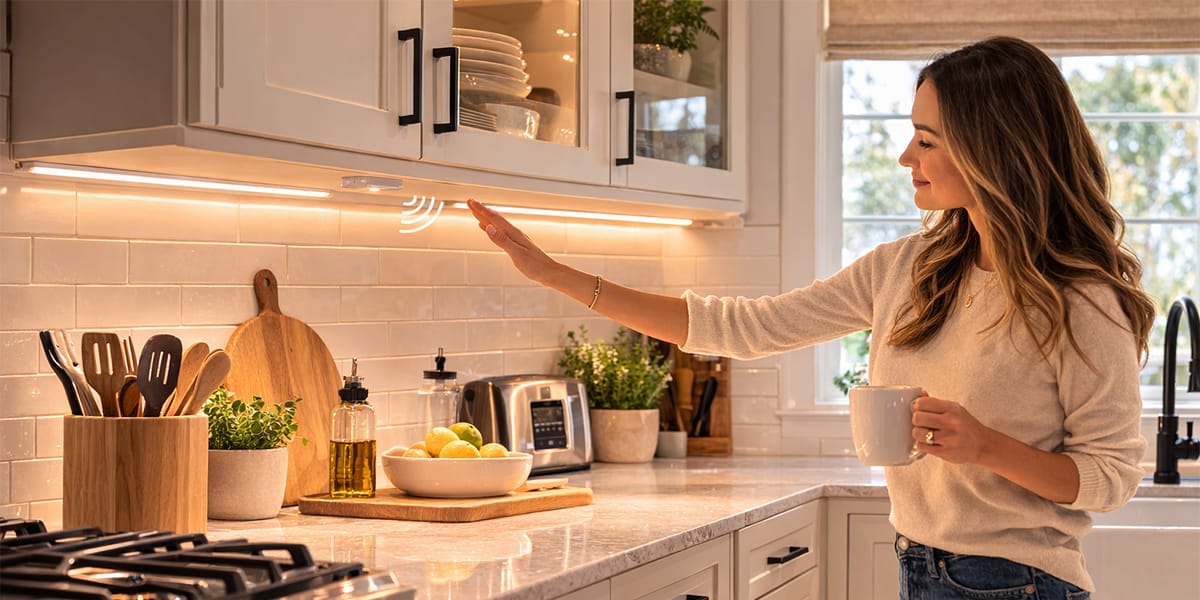
Perfect for cooking areas. When your hands are wet or greasy, you can simply wave your hand under the sensor to turn the light on or off.
Door-activated lights
These are installed inside cabinets. The light turns on automatically when the door opens, making it easier to find items stored in darker shelves.
Each type solves a slightly different problem, so the best option often depends on how the kitchen is used.
Choosing the Right Quality and Protection Level
Because kitchens contain steam, grease, and cleaning moisture, product quality matters.
If you plan to install cabinet lighting, I strongly recommend choosing lights with at least an IP65 protection rating. This level of sealing helps protect internal circuits from dust, cooking fumes, and occasional water splashes.
Good sealing reduces the risk of electrical problems and extends the lifespan of the lighting system.
A well-made lighting unit should last for years without requiring frequent replacement.
Understanding the Cost
Budget is always part of renovation decisions, and fortunately cabinet sensor lights are relatively affordable compared with many kitchen upgrades.
There are generally two main types on the market:
Wireless battery-powered lights
These are the easiest to install and work well in finished kitchens where adding new wiring would be difficult. Most mid-range models cost around $10 to $20 per light, making them a popular option for quick upgrades.
Hardwired systems
These are typically installed during a full renovation when electrical lines can be planned in advance. While installation costs are higher, hardwired lights tend to be more stable and require less maintenance over time.
For homeowners planning to stay in their home long term, hardwired lighting can be a worthwhile investment.
A Smart Strategy for Budget-Friendly Kitchens
Not every cabinet needs lighting.
If your budget is limited, a simple and effective strategy is to install just one sensor light in the main food preparation zone. This area benefits the most from improved visibility.
Rechargeable wireless lights with magnetic mounts are another practical option. They can be installed without drilling and easily repositioned if needed.
This approach keeps costs low while still delivering the biggest functional improvement.
Why More Modern Homes Include Sensor Lighting
In recent years, many higher-end residential developments have started including cabinet sensor lighting as a standard feature.
This trend reflects a growing understanding that good lighting dramatically improves daily comfort. Much like soft-close drawers or pull-out organizers, under-cabinet lighting has gradually moved from a luxury feature to a practical design upgrade.
As smart home technology continues to evolve, these lighting systems may eventually become a normal part of modern kitchen design.
Final Thoughts
So, do you really need cabinet sensor lights?
The honest answer is it depends on how you use your kitchen.
If cooking is a regular part of your daily routine, under-cabinet lighting can improve visibility, reduce shadows, and make food preparation safer. Motion-activated lights also add convenience during nighttime visits to the kitchen.
But like any home upgrade, the best choice comes from balancing practical needs, family habits, and budget.
From a designer’s perspective, cabinet sensor lights are not just about aesthetics. When installed thoughtfully, they can make the kitchen feel more comfortable, safer, and easier to use every single day—and sometimes those small improvements make the biggest difference in a home.


About author

Related posts

Kitchen base cabinets do more than support the countertop. Their internal configuration affects how easily cookware, utensils, dishes, and everyday supplies can be stored and... Continue reading

Kitchen cabinet quotes can vary significantly even when they appear to cover the same kitchen. One quote may include plywood cabinet boxes, finished panels, fillers,... Continue reading

A knee drawer is a specialized vanity cabinet component designed to add storage while creating comfortable open space underneath a bathroom countertop. Knee drawers are... Continue reading

A 33-inch farmhouse sink is a common choice for a 36-inch base cabinet, but it is not a universal rule. The correct fit depends on... Continue reading

A kitchen cabinet filler is a narrow finished strip used to close or manage the space between a cabinet and a wall, appliance, corner, or... Continue reading





Add comment