No products in the cart.
Return To Shop or
or  ,
,


Are RTA Cabinets Real Wood?
Short answer: Yes — but not in the way most homeowners imagine.
Many shoppers assume “real wood” means the entire cabinet is carved from thick, solid hardwood.
Here’s the truth: most well-built RTA cabinets use real wood where it counts visually — the doors, drawer fronts, and sometimes the face frames — while the cabinet boxes themselves are made from engineered panels. This keeps the cabinets stable, affordable, and easy to ship.
This “hybrid construction” isn’t a compromise.
It’s actually the same method used by many luxury cabinet manufacturers, because:
- Solid wood looks great but moves with humidity
- Plywood holds screws better and resists moisture
- MDF gives a flawless painted finish
- Combining the right materials gives you better performance and a better price
If you’re a homeowner, DIYer, or designer trying to evaluate whether an RTA line is really worth the investment, the key is understanding which parts are real wood — and why smart manufacturers don’t make 100% solid-wood cabinets for kitchens.
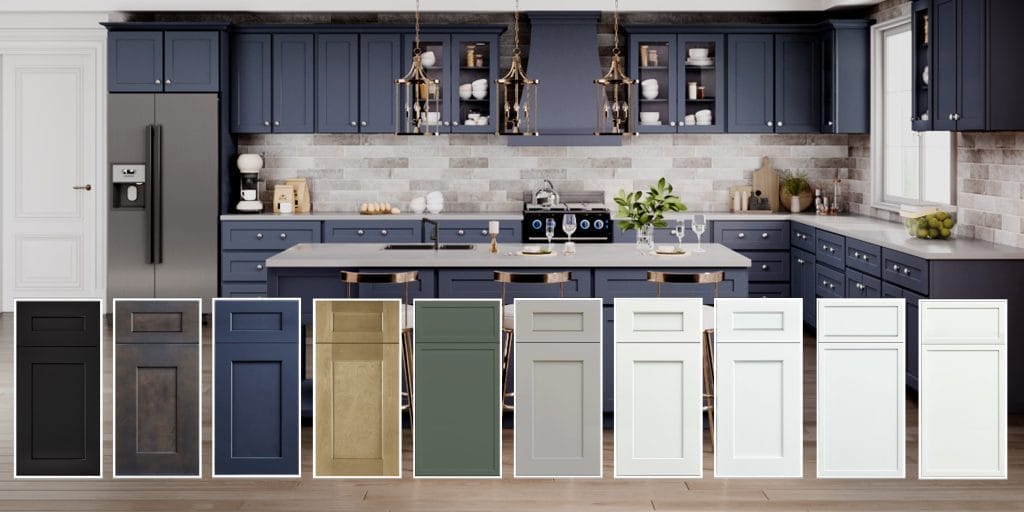
Many RTA (Ready-To-Assemble) cabinets do include real wood — but “real wood” rarely means “every single piece is solid, kiln-dried hardwood.” In most sensible RTA lines you’ll see a blended approach: real-wood doors or face frames paired with engineered or plywood cabinet boxes. That combination gives you the look and tactile warmth of wood where it matters most, while keeping the cost, stability, and delivery time practical for real home projects.
Below I walk through the terms, the typical material mix you’ll encounter, why the mix matters for performance and style, and how to translate material choices into smart purchase, installation, and remodel decisions. This is written for homeowners (especially hands-on DIYers), partners who do the installations, and designers or contractors who need to advise clients confidently.
Table of Contents
Understanding RTA Cabinets & Material Terminology
What is an RTA cabinet?
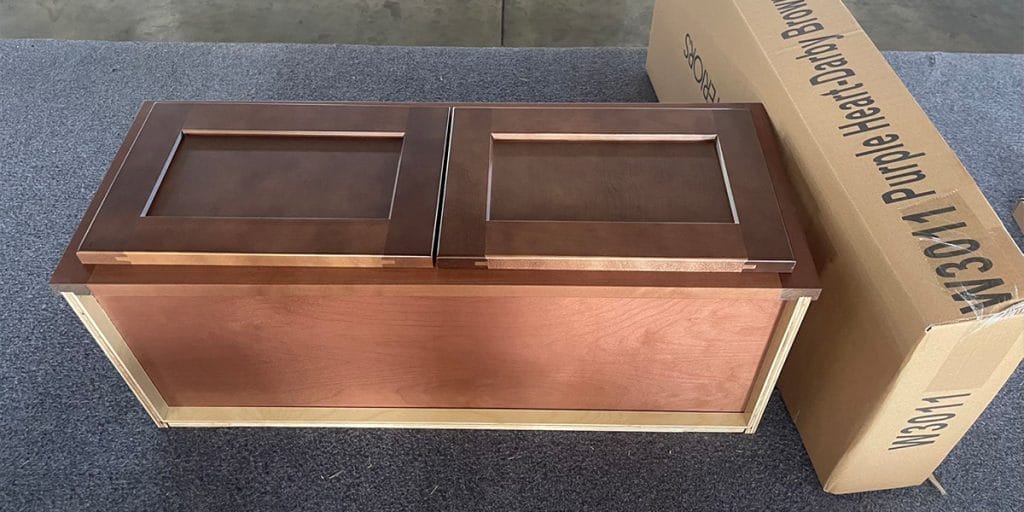
RTA stands for Ready-To-Assemble. Cabinets are shipped flat, often in standardized sizes, and assembled on-site by the homeowner or installer. Because the product is standardized and packed compactly, manufacturers save on production and shipping — savings that can be passed along to you. To learn more about why RTA cabinets can be so affordable, see Why Are RTA Cabinets So Cheap?.
Common material terms you’ll see in listings
- Solid wood / Solid hardwood: Single pieces or stiles/rails made from hardwood species (maple, oak, cherry, walnut). Solid wood is prized for its grain and feel but moves with humidity.
- Hardwood vs. softwood: Hardwood comes from broadleaf trees (oak, maple); softwood from conifers (pine). “Hardwood” is often implied when manufacturers say “real wood,” but check the species.
- Plywood: Several thin veneers glued at alternating grain directions. Strong, dimensionally stable, and commonly used for cabinet boxes.
- MDF / HDF (Medium / High Density Fiberboard): Compressed wood fibers. Smooth, good for painted finishes and cheaper than plywood, but heavier and less moisture-resistant.
- Particleboard: Pressed wood particles. Least expensive; deserves caution in wet or steam-heavy kitchens.
- Veneer / wood veneer: A thin slice of real wood adhered to an engineered substrate (plywood/MDF). Gives a real-wood look without the cost of solid wood.
For a more detailed explanation of different cabinet materials and their pros and cons, check out 5 Cabinet Materials You Should Know.
So what does “real wood” mean in RTA cabinets?
Often it means some key surfaces are wood — most commonly the door face, drawer front, or face frame — while the internal cabinet box is an engineered panel (plywood, MDF, or particleboard). High-end RTA lines may use plywood boxes with solid hardwood doors; entry-level RTA often pairs particleboard boxes with either veneered doors or painted MDF.
How Much ‘Real Wood’ Is in RTA Cabinets?
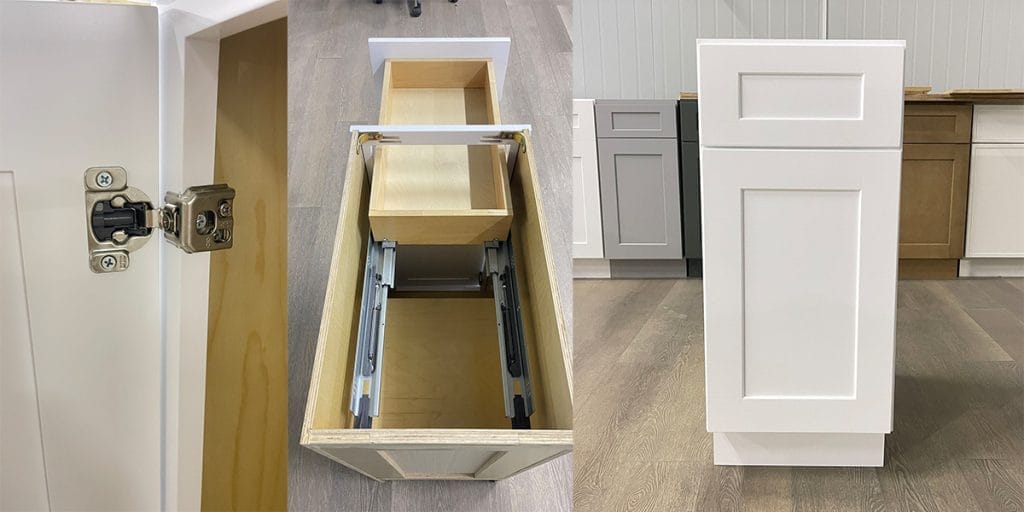
Typical construction breakdown
- Cabinet carcass (box): Frequently plywood or MDF in better RTA lines; some budget lines use particleboard. Plywood is preferable in kitchens because it resists moisture and holds screws better.
- Door and drawer faces: This is where manufacturers most commonly use real hardwood — either solid rails and stiles with a center panel, or a hardwood veneer over a stable core. Many RTA sellers specifically advertise “real wood doors” while noting the box is plywood or MDF.
- Face frames and trim: Higher-quality RTA often has solid-wood frames, which improve longevity and allow for refinishing.
What to ask the seller
If you see “real wood” in product copy, clarify:
- Which components are real wood (doors? frames? boxes?)
- Is the box plywood or particleboard? What thickness?
- Is the door solid wood, solid-wood frame with MDF panel, or veneer?
- What species of wood and what finish system is used?
A realistic expectation
It’s common — and perfectly acceptable — to have real wood door faces with engineered boxes. That arrangement delivers the visible benefits of wood while avoiding the cost and moisture-sensitivity of solid-wood boxes.
RTA Cabinet Material Comparison Table
| Component / Feature | Solid Hardwood | Plywood | MDF | Particleboard |
|---|---|---|---|---|
| What it is | Single-species real wood | Engineered layers of veneer | Compressed wood fibers with resin | Pressed wood chips |
| Best use | Doors, drawer fronts, trims | Cabinet boxes, shelves, drawers | Painted doors and panels | Budget box construction |
| Strength | Strong but moves with humidity | Very strong & stable | Stable but heavy | Weak |
| Moisture resistance | Expands/contracts | Good | Poor (swells with water) | Very poor |
| Screw-holding power | Good | Excellent | Weak | Very weak |
| Finish options | Stain or paint | Paint or veneer | Paint only | Paint only |
| Cost | Highest | Moderate | Low to moderate | Lowest |
| Common RTA use | Door frames, drawer fronts | Boxes, shelves | Painted panels | Budget boxes |
| Appearance | Natural wood grain, warm | Wood-like, veneered or painted | Smooth, flat | Uniform, less natural |
| Durability | Long-lasting if maintained | Very durable | Durable for painted surfaces | Less durable, prone to damage |
Quick Ways to Tell Real Wood from Engineered Wood
A practical guide for homeowners before buying RTA cabinets
When you shop for kitchen cabinets, especially online, it can be hard to tell whether a product is real solid wood or engineered wood. The following simple and factual methods can help you identify the material quickly without tools.
1. Look at the Wood Grain
Real wood has natural variations in color and pattern. No two areas look exactly the same.
Engineered wood, including MDF or particleboard with veneer, usually has a very uniform grain. The pattern may repeat or look overly perfect.
A helpful tip is to look at the back of the door. If the grain is identical on both sides, it is almost always veneer, not solid wood.
Common misunderstanding: Uniform grain does not mean better quality. It only indicates it is not solid wood. Veneer is widely used and not necessarily low quality.
2. Check the Edge or Back Side
Solid wood is a single piece, and the wood fibers run continuously through the thickness.
Veneered panels, whether MDF, particleboard or plywood, show a thin top layer and a different inner core. You can often see a clear transition line.
This method helps you understand what you are buying. Veneer construction is common and often used for stability.
Common misunderstanding: Having veneer does not mean the cabinet is cheap. Many high-end cabinets use solid wood frames with MDF or veneered center panels to prevent warping.
3. Tap Test
Lightly knock on the door surface with your knuckles.
Solid wood usually produces a brighter and crisper sound.
MDF tends to sound deeper and heavier.
Particleboard often sounds slightly hollow.
This test identifies the type of material, not whether it is good or bad. For example, a high-quality paint-grade MDF door may sound dull but perform extremely well.
Common misunderstanding: Louder sound does not mean higher quality. It only reflects density differences.
3. Weight Feel
Solid wood doors have medium weight depending on the species.
MDF doors are typically heavier because MDF is dense.
Particleboard doors feel lighter and less rigid.
Weight helps you narrow down the material type, but it is not a quality indicator.
Common misunderstanding: Heavy does not mean solid wood. In fact, very heavy doors are usually MDF.
Ask Three Key Questions (Best for online shopping)
What is the cabinet box made of? Typical answers are plywood, MDF or particleboard.
How is the door constructed? Common structures include solid wood frames with MDF center panels, all solid wood, or veneer over engineered wood.
What is the panel thickness? Quality cabinet boxes are usually three quarter inch. Half inch is more budget oriented.
These three questions give you a clear picture of what you are paying for.
Common misunderstanding: All solid wood doors are not always the best. Solid center panels may shrink or crack. Many professional designers prefer solid frames with MDF centers for painted doors.
Smell Test (In-store only)
Real wood has a light natural wood scent.
Engineered wood may have a faint resin or adhesive smell.
For online shopping, look for CARB2 or TSCA Title VI certification to ensure low emissions.
Common misunderstanding: A slight chemical smell does not mean poor quality. All engineered boards use adhesives; the key is whether they meet safety standards.
These methods help you understand what materials you are buying, not judge them as good or bad. Solid wood is excellent for frames. MDF is ideal for painted doors. Plywood is preferred for cabinet boxes. Veneer is stable and common in modern construction. The goal is to make informed decisions and avoid misleading marketing terms such as “all solid wood” when the construction is actually mixed for practical reasons.
Why the Material Mix Matters
Durability & stability
- Solid wood looks and smells great, but it expands and contracts with humidity. In kitchens where steam and temperature changes are frequent, that movement can lead to gaps or warping if wood is not properly sealed and installed with appropriate clearance.
- Plywood is far more dimensionally stable in humid environments and holds screws and fasteners well — why many pros prefer plywood for cabinets’ internal structure. To learn more about the different materials used in kitchen cabinets, see Kitchen Cabinet Materials Explained.
- MDF is stable and ideal for painted doors because it paints smoothly; however, it swells if exposed to water and won’t hold screws as well as plywood.
Design and finish flexibility
- If you want stained natural grain (walnut, oak, cherry), real wood doors or veneers are the obvious choice. The grain gives warmth and a tactile quality that paint can’t quite replicate.
- If you want crisp, modern colors or ultra-matte whites, painted MDF or painted plywood doors create cleaner, flatter surfaces.
Cost vs. longevity tradeoff
- A full solid-wood build is the most expensive and, unless built with stable joinery and properly kiln-dried stock, not always the longest-lasting in a kitchen environment.
- A practical, designer-approved approach is the “golden combo”: solid-wood (or veneered hardwood) doors with a plywood carcass and quality hardware. This delivers longevity, looks, and cost restraint.
Hardware and details matter more than you might think
Good hinges, soft-close slides, edge banding, and proper sealing of exposed wood edges often determine whether a cabinet ages gracefully. Spend some of your budget here even if the box is engineered wood. For a deeper dive into choosing the right components, check out Cabinet Hardware & Finishes Explained.
Translating Material Knowledge into Style, Colour & Remodel Advice
Style suggestions tied to materials
- Farmhouse / Classic: Choose solid-wood doors or wood veneer with pronounced grain (oak, pine, or alder). Let the wood be the focal point: warm stains, larger island in solid wood, and vintage-style metal handles. Learn more about Farmhouse Kitchen Cabinet Styles & Inspirations.
- Modern / Minimalist: Use painted MDF or veneered plywood doors for a flawless, handle-less look. Light neutral paint on clean lines keeps the space visually calm.
- Eclectic / Mixed: Combine dark stained lower cabinets (real wood) with painted upper cabinets (MDF) and use natural wood open shelving to bridge both looks.
Colour guidance
Wood tones read warm and approachable. Oak and maple provide honeyed warmth; walnut and mahogany are richer and more formal. Painted colors (navy, charcoal, soft sage) are simpler on MDF or plywood and create bold contrast with wood tones. Explore the Top 5 Kitchen Cabinet Colors for 2025 for more ideas.
Renovation tactics
- Keep the boxes, change the faces. If your existing boxes are square and sturdy, replacing only door fronts and drawer faces (with real wood or veneered options) delivers a dramatic aesthetic lift at a fraction of the cost of full replacement.
- Go plywood for boxes, wood for faces. When buying new RTA cabinets, prioritize plywood carcasses and invest in solid or veneered doors. This is the best ratio of cost to long-term performance.
- Use saved funds for visible upgrades. Spend the money you save on a nicer countertop, better lighting, or a show-stopping backsplash — those are the features people notice first.
Installation & maintenance tips
- Allow small gaps for wood expansion and contraction; don’t force doors into perfectly rigid frames.
- Seal the back of wooden doors or veneer edges if they may see moisture.
- Use quality fasteners; plywood accepts screws better than particleboard.
- Periodically check hinge tension and drawer slide alignment — small adjustments keep everything operating smoothly for years. See our Cabinet Installation 101 DIY Guide for step-by-step tips.
Budget allocation example
If your total kitchen budget is constrained, treat cabinetry as 30–40% of the total. But within that allocation:
- 60% toward cabinet boxes + doors (prioritize plywood boxes + wood/veneer doors)
- 20% toward countertops and backsplashes (visual focal points)
- 20% toward hardware & lighting (these elevate perceived quality)
Key Takeaways & Next Steps for Readers
Bottom line
Many RTA cabinets include real wood where it matters visually — on doors and drawer faces — while relying on engineered materials for the hidden structure. That’s an intelligent, widely accepted construction strategy that balances beauty, durability, and cost.
What to do before you buy
- Ask for specifics — cabinet box material, door construction (solid, framed, veneered), species, finish type, and warranty.
- Request a sample — feel the door and edge finish; check veneer seams and paint quality.
- Check hardware specs — look for full-extension drawer slides and concealed soft-close hinges.
- Plan for the environment — if you live in a steamy climate or have poor ventilation, favor plywood carcasses and sealed doors.
- Consider the golden combo — real wood or veneered doors + plywood box + high-quality hardware = the best cost-to-value outcome.
A designer’s closing note
Wood is an emotional material — it adds warmth, texture, and personality. But in kitchens, where performance matters, the smartest projects use wood where it’s most visible and engineered stability where it matters structurally. Adopt that mindset and you’ll get a kitchen that feels like real wood and lasts like a thoughtfully built home.


Related posts

When renovating a bathroom, most homeowners focus heavily on comparing materials and styles for bathroom vanities, yet many overlook an equally important factor: installation height.... Continue reading

In modern kitchen design, stainless steel kitchen cabinets have become a popular choice for homeowners who value both practicality and visual appeal. Made primarily from... Continue reading
A kitchen is more than just a place to cook. It is where mornings begin with coffee, where families gather for meals, and where everyday... Continue reading

Receiving the keys to a new home is an exciting milestone yet it often brings an important and sometimes confusing question. What is the best... Continue reading

The kitchen is far more than a place for cooking meals. In many American homes it has become a central space for daily routines family... Continue reading








Add comment