No products in the cart.
Return To Shop.png?sharp=1)


Are RTA Cabinets Real Wood?
Short answer: Some RTA cabinets contain real wood, but RTA does not describe a cabinet material. It only means Ready-to-Assemble.
An RTA cabinet may use solid wood, plywood, HDF, MDF, particleboard, or a combination of several materials. The important question is not simply whether the cabinet is “real wood,” but which material is used for each component.
For example, a cabinet may combine a plywood box with a solid-wood face frame and an HDF painted door. Another cabinet may use veneered panels or particleboard. Both can still be sold as RTA cabinets because RTA describes how the cabinet is delivered and assembled—not what it is made from.
When comparing RTA cabinets, check the construction of the cabinet box, doors, face frame, drawers, shelves, and hardware separately. This guide explains what the common materials mean and how to tell what you are actually buying.e whether an RTA line is really worth the investment, the key is understanding which parts are real wood — and why smart manufacturers don’t make 100% solid-wood cabinets for kitchens.
Table of Contents
Understanding RTA Cabinets & Material Terminology
What is an RTA cabinet?
RTA stands for Ready-to-Assemble. The cabinet components are packaged for assembly before installation rather than arriving fully assembled.
Importantly, RTA describes the delivery and assembly format—not the cabinet material or quality level. An RTA cabinet can be made from plywood, solid wood, HDF, MDF, particleboard, or combinations of these materials.
why RTA cabinets can be so affordable, see Why Are RTA Cabinets So Cheap?.
Common material terms you’ll see in listings
- Solid wood / Solid hardwood: Single pieces or stiles/rails made from hardwood species (maple, oak, cherry, walnut). Solid wood is prized for its grain and feel but moves with humidity.
- Hardwood vs. softwood: Hardwood comes from broadleaf trees (oak, maple); softwood from conifers (pine). “Hardwood” is often implied when manufacturers say “real wood,” but check the species.
- Plywood: Several thin veneers glued at alternating grain directions. Strong, dimensionally stable, and commonly used for cabinet boxes.
- MDF / HDF (Medium / High Density Fiberboard): Compressed wood fibers. Smooth, good for painted finishes and cheaper than plywood, but heavier and less moisture-resistant.
- Particleboard: Pressed wood particles. Least expensive; deserves caution in wet or steam-heavy kitchens.
- Veneer / wood veneer: A thin slice of real wood adhered to an engineered substrate (plywood/MDF). Gives a real-wood look without the cost of solid wood.
For a more detailed explanation of different cabinet materials and their pros and cons, check out 5 Cabinet Materials You Should Know.
So what does “real wood” mean in RTA cabinets?
Often it means some key surfaces are wood — most commonly the door face, drawer front, or face frame — while the internal cabinet box is an engineered panel (plywood, MDF, or particleboard). High-end RTA lines may use plywood boxes with solid hardwood doors; entry-level RTA often pairs particleboard boxes with either veneered doors or painted MDF.
How Much ‘Real Wood’ Is in RTA Cabinets?
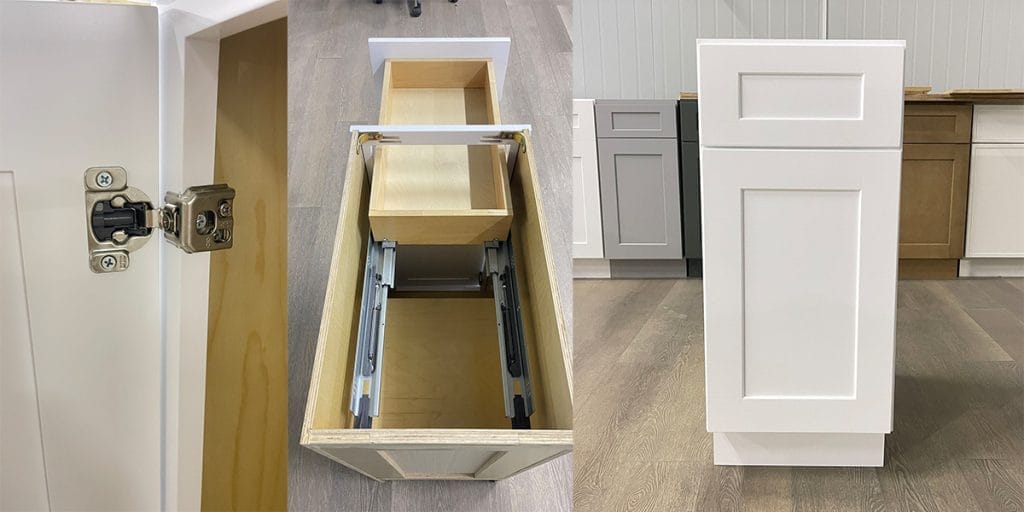
Where You May Find Real Wood in an RTA Cabinet
Cabinet box: Plywood, MDF, and particleboard are all used in RTA cabinet boxes. Plywood is especially common in cabinet lines designed around a stronger structural box.
Doors and drawer fronts: Construction varies widely. Shaker doors may use solid-wood rails and stiles, HDF/MDF components, veneered panels, or combinations of these materials.
Face frame: Framed RTA cabinets may use a solid-wood face frame even when the cabinet box itself is plywood.
Drawer box: Depending on the cabinet line, drawers may use solid wood, plywood, engineered panels, or combinations of materials.
Shelves and back panels: These are commonly plywood or engineered panels rather than solid hardwood.
What to ask the seller
If you see “real wood” in product copy, clarify:
- Which components are real wood (doors? frames? boxes?)
- Is the box plywood or particleboard? What thickness?
- Is the door solid wood, solid-wood frame with MDF panel, or veneer?
- What species of wood and what finish system is used?
A Real RTA Cabinet Construction Example
A useful way to understand hybrid cabinet construction is to look at the specification of an actual cabinet line.
For example, RARA’s Opulent Shaker White RTA Kitchen Cabinets use:
- 1/2″ plywood cabinet boxes
- A solid-wood face frame
- HDF door frames and center panels
- 9/16″ dovetail drawer boxes
- 3/4″ adjustable shelves
- Concealed adjustable soft-close hinges
- Undermount full-extension soft-close drawer glides
This illustrates why the question “Is it real wood?” does not tell you enough about cabinet quality. Different materials can be selected for different parts of the cabinet based on structural requirements, finish, stability, and cost.
A realistic expectation
It’s common — and perfectly acceptable — to have real wood door faces with engineered boxes. That arrangement delivers the visible benefits of wood while avoiding the cost and moisture-sensitivity of solid-wood boxes.
RTA Cabinet Material Comparison Table
| Material | Common Cabinet Uses | Main Advantage | Main Consideration |
|---|---|---|---|
| Solid Wood | Face frames, door components, trim | Natural grain and strong structural components | Moves with humidity |
| Plywood | Cabinet boxes, shelves, backs | Strong and dimensionally stable | Quality varies by thickness and veneer/core construction |
| HDF / MDF | Painted doors and panels | Smooth, consistent painted surface | Must be protected from prolonged water exposure |
| Particleboard | Cabinet boxes and panels in some lines | Economical and dimensionally consistent | Edge sealing and moisture protection are especially important |
| Wood Veneer | Doors, panels, finished surfaces | Real wood appearance with a stable core | Veneer thickness and substrate quality vary |
How to Tell What Your RTA Cabinets Are Made Of
A practical guide for homeowners before buying RTA cabinets
When you shop for kitchen cabinets, especially online, it can be hard to tell whether a product is real solid wood or engineered wood. The following simple and factual methods can help you identify the material quickly without tools.
1.Read the Construction Specifications
Start with the manufacturer’s specification sheet. Look for separate descriptions of the cabinet box, door, face frame, drawer box, shelves, and back panel.
Avoid relying only on phrases such as “wood construction” or “all-wood cabinetry.” Ask which exact components are solid wood, plywood, HDF/MDF, particleboard, or veneer.
2.Check Exposed Edges and Unfinished Areas
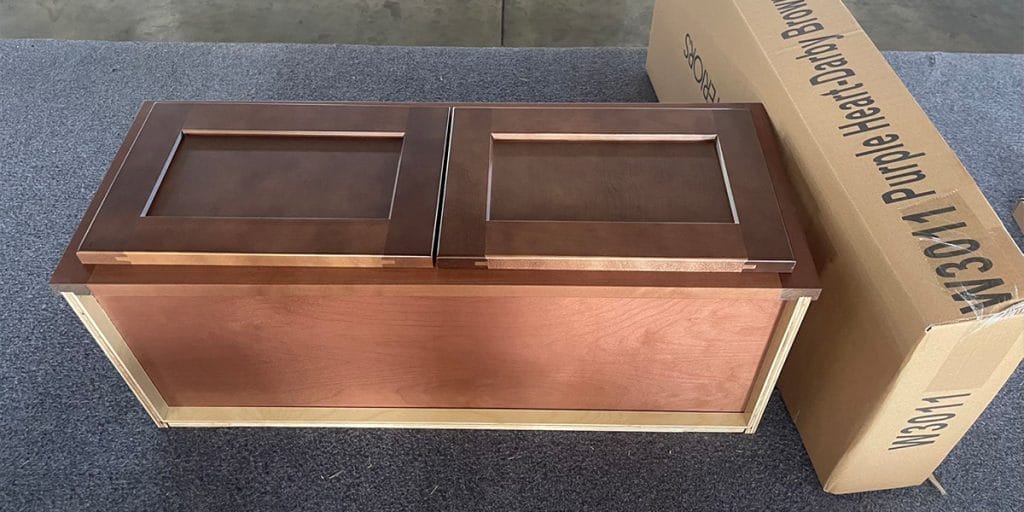
Solid wood shows continuous wood fibers through the material. Plywood typically reveals multiple thin layers at an exposed edge, while MDF and particleboard have a more uniform fiber or particle core.
Veneered panels have a thin real-wood surface bonded over a different core material.
3. Inspect a Sample Door
If you are buying cabinets online, order a sample door when available. Inspect the front, back, edges, joints, and finish rather than judging the material from website photography alone.
A sample can also help you evaluate paint quality, veneer seams, door construction, and color under your actual kitchen lighting.
4.Ask These Four Questions Before Buying
What is the cabinet box made of? Typical answers are plywood, MDF or particleboard.
How is the door constructed? Common structures include solid wood frames with MDF center panels, all solid wood, or veneer over engineered wood.
What is the panel thickness? Box thickness should be evaluated together with the material, back-panel construction, joinery, reinforcement, shelf design, and installation method. Thickness alone does not determine cabinet quality.
These three questions give you a clear picture of what you are paying for.
Common misunderstanding: All solid wood doors are not always the best. Solid center panels may shrink or crack. Many professional designers prefer solid frames with MDF centers for painted doors.
Why Different Materials Are Often Combined
Using several materials in one RTA cabinet is not automatically a sign of lower quality. Cabinet manufacturers often choose different materials because each part of the cabinet has different structural, finish, and stability requirements.
For example:
- Solid wood can provide natural grain and strong components for face frames, door rails, door stiles, and trim.
- Plywood works well for cabinet boxes, shelves, and other structural parts because it offers good strength and dimensional stability.
- HDF or MDF can provide a smooth, uniform surface for painted cabinet doors and panels.
- Wood veneer can provide a natural wood appearance while using a more dimensionally stable core material underneath.
The important question is not whether every part of the cabinet is made from the same material. It is whether the material is appropriate for the component and whether the cabinet is properly constructed, finished, and supported by reliable hardware.
Durability and Stability
Different cabinet materials react differently to humidity, temperature, and daily use.
Solid wood naturally expands and contracts as humidity changes. This movement is normal, but it can become visible at joints or panel edges if the door construction and finish do not allow for seasonal movement.
Plywood is commonly used for cabinet boxes because its layered construction provides good structural strength and dimensional stability.
HDF and MDF are commonly used for painted doors because their smooth surface can produce a consistent painted finish. However, these materials should still be protected from prolonged exposure to water, especially around unfinished edges.
Finish and Appearance
Material choice also affects the final appearance of the cabinet.
If you want visible natural grain, stained solid wood or wood veneer is usually the better choice.
For painted Shaker doors, HDF, MDF, and other paint-grade materials can provide a smoother and more uniform surface than many natural wood components.
No single material is automatically best for every cabinet part. The right choice depends on whether the priority is natural grain, painted finish quality, structural strength, moisture resistance, or cost.
Hardware Still Matters
Cabinet material is only one part of overall cabinet quality.
Hinges, drawer slides, drawer construction, edge sealing, back-panel construction, and installation quality also affect how well a cabinet performs over time.
When comparing RTA cabinets, evaluate the cabinet as a complete system rather than judging quality by the phrase “real wood” alone.
Is Solid Wood Always Better for RTA Cabinets?
No. Solid wood can be an excellent cabinet material, but using more solid wood does not automatically make an RTA cabinet better.
Different cabinet components have different requirements. Solid wood works well where natural grain, strength, and appearance are important, while plywood offers good dimensional stability for cabinet boxes and shelves. HDF and MDF can also be practical choices for painted doors because their smooth, uniform surfaces help create a consistent painted finish.
Instead of asking whether a cabinet is “all solid wood,” compare how each part of the cabinet is constructed.
Before buying, check:
- Cabinet box material: Look at whether the box is plywood, MDF, particleboard, or another engineered panel, and check the material thickness and back-panel construction.
- Door construction: Determine whether the door uses solid wood, an HDF/MDF painted panel, veneer, or a combination of materials.
- Drawer construction: Check the drawer-box material, joinery, and how the drawer bottom is supported.
- Shelves: Look at the shelf material, thickness, and support system, especially for wide wall or pantry cabinets.
- Hinges and drawer slides: Adjustable hinges and smooth, full-extension drawer slides can have a major impact on daily use.
- Finish quality: Check the consistency of painted or stained surfaces, especially around edges, joints, and door backs.
- Warranty: Review what the manufacturer covers for cabinet structure, hardware, and finish.
A well-designed combination of materials can be more practical than using solid wood for every cabinet component. The goal is to choose the right material for the right job rather than simply maximizing the amount of solid wood.
Key Takeaways: What to Check Before Buying RTA Cabinets
RTA cabinets are not defined by a specific material. “RTA” only means Ready-to-Assemble, so the construction can vary significantly from one cabinet line to another.
Some RTA cabinets use solid wood components, while others combine plywood, HDF, MDF, veneer, or particleboard. A mixed-material cabinet is not automatically lower quality. What matters is whether each material is appropriate for its intended use and how well the cabinet is constructed.
Before You Buy, Check These 6 Things
- Cabinet box construction
Confirm whether the box is made from plywood, MDF, particleboard, or another material, and check the box and back-panel specifications. - Door construction
Ask whether the doors are solid wood, HDF/MDF, veneer, or a combination of materials. For Shaker doors, check both the rails and stiles and the center panel. - Drawer construction
Review the drawer-box material, joint construction, drawer-bottom support, and slide system. - Hardware
Look for adjustable hinges and drawer slides that operate smoothly and are appropriate for the expected load. - Finish and edge quality
Check painted or stained surfaces for consistent coverage, especially around door edges, joints, and panel backs. - Warranty and product specifications
Read the manufacturer’s specifications and warranty rather than relying only on terms such as “real wood,” “all wood,” or “premium construction.”
One of the Best Ways to Verify Cabinet Quality
If you are shopping online, ordering a sample door can help you inspect the material, finish, edge construction, joints, and color before purchasing a full kitchen.
A sample does not tell you everything about the cabinet box or hardware, so combine it with the product specifications and construction details before making a decision.
Final Answer: Are RTA Cabinets Real Wood?
Some RTA cabinets contain real wood, but not all RTA cabinets are solid wood—and they do not need to be.
A well-constructed RTA cabinet may combine solid wood, plywood, HDF, MDF, or veneer depending on the component. Instead of asking only whether the cabinet is “real wood,” compare where each material is used, how the cabinet is constructed, and what warranty supports it.
That gives you a much more useful picture of cabinet quality than the phrase “real wood” alone.


About author

Related posts

Kitchen base cabinets do more than support the countertop. Their internal configuration affects how easily cookware, utensils, dishes, and everyday supplies can be stored and... Continue reading

Kitchen cabinet quotes can look similar at first but include very different products and services. One quote may include plywood cabinet boxes, finished end panels,... Continue reading

A knee drawer is a specialized vanity cabinet component designed to add storage while creating comfortable open space underneath a bathroom countertop. Knee drawers are... Continue reading

A 33-inch farmhouse sink is a common choice for a 36-inch base cabinet, but it is not a universal rule. The correct fit depends on... Continue reading

A kitchen cabinet filler is a narrow finished strip used to close or manage the space between a cabinet and a wall, appliance, corner, or... Continue reading





Add comment