No products in the cart.
Return To Shop or
or  ,
,


3 Key Factors to Consider When Choosing a Bathroom Vanity
As one of the most important functional areas in the home, the bathroom has received increasing attention in both renovation and interior planning. Well designed and finely crafted bathroom vanities have gradually become a key focus when selecting materials and fixtures. Faced with the wide variety of styles and materials available on the building materials market, many homeowners find themselves unsure of how to make the right choice. The following guide offers a clear and practical overview to help you select a bathroom vanity with confidence.
Table of Contents
Pay Close Attention to Materials
A bathroom vanity is furniture that remains in a humid environment for long periods and is frequently exposed to water and moisture. For this reason, material selection should always be the top priority. The chosen panels must be moisture resistant, structurally strong, and durable enough to withstand daily use without warping or damage. Homeowners should therefore approach material choices with particular care.

Among the options available on the market, multi layer plywood is widely regarded as a reliable choice. During the manufacturing process, wood layers are compressed and arranged in alternating directions, which helps reduce internal stress. This structure makes the panel less prone to deformation or cracking over time. When purchasing a vanity, quality should always take precedence over price, as choosing inexpensive materials often leads to higher maintenance costs later.
Industry professionals also advise avoiding particle board and medium density fiberboard whenever possible. Particle board is typically made by compressing wood chips in the core and covering the surface with a thin veneer. When exposed to moisture, this material easily swells, cracks, and deteriorates, and lower quality adhesives may release excessive formaldehyde. Medium density fiberboard performs slightly better and is commonly used due to its low cost, but it also has clear drawbacks. Once hinges are misaligned and need to be removed and reinstalled, it can be difficult to secure them firmly again, which affects long term stability.
Consider the Washbasin Carefully
The washbasin is an essential component of the bathroom vanity, and its selection deserves equal attention. When choosing a basin, the first factor to consider is how well it fits the overall space. Freestanding basins are visually appealing, occupy less floor area, and are relatively easy to maintain, making them suitable for smaller bathrooms. Countertop basins require more space, roughly equivalent to a small desk, but offer practical advantages. The countertop provides room for toiletries, while the cabinet below can store miscellaneous items. The choice between these two types should be based on the size and layout of the bathroom.

Height is another crucial factor. Whether freestanding or countertop, the top of the basin or counter should generally be positioned about eighty to eighty five centimeters above the floor. This height helps prevent strain on the lower back during daily use. Basin depth and faucet selection are also closely related. Deeper basins are better suited to faucets with stronger water flow, while shallow basins paired with large faucets often cause water to splash onto the user. The bottom of the basin should have a gentle curve rather than a flat surface, ensuring that water drains smoothly instead of pooling.
Surface finish should never be overlooked. Experts emphasize that the joint between the basin and the countertop must be smooth. A seamless connection allows water splashed onto the counter to be wiped back into the basin easily and also makes routine cleaning more convenient.
Do Not Overlook Bathroom Hardware
During bathroom renovation, hardware fittings are often underestimated. In reality, carefully selected hardware can significantly enhance both comfort and overall visual quality. Items such as hinges, handles, and hanging accessories may be small, but they play an important role in daily use.
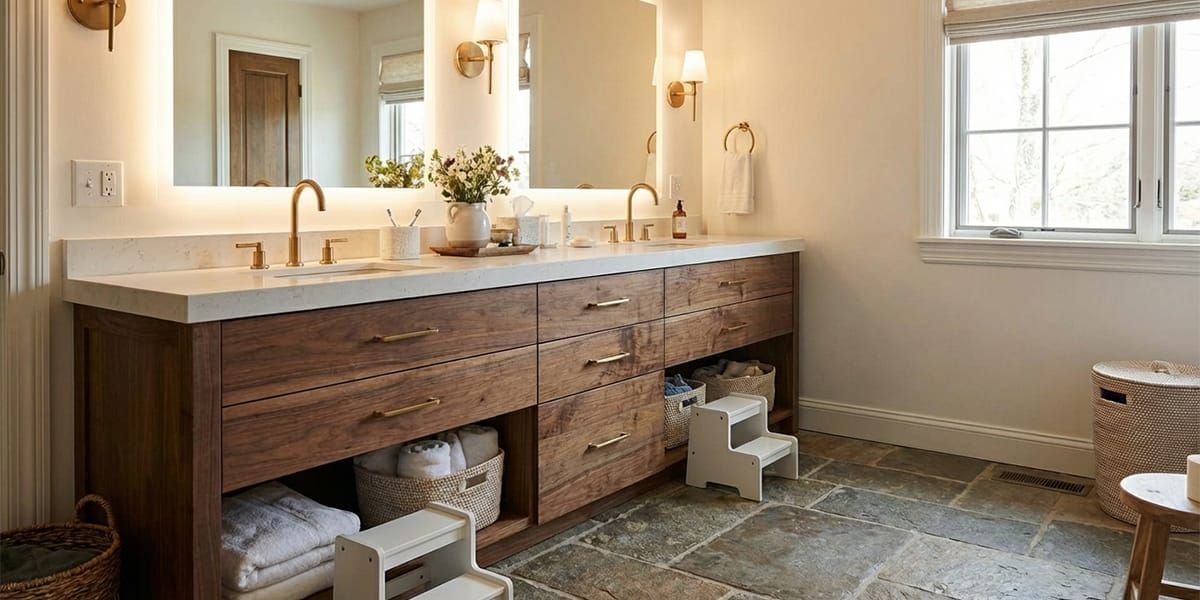
Generally speaking, solid brass hardware is superior to products made from other materials. Brass fittings cast from pure copper tend to have a dense internal structure, feel heavier in hand, and offer greater durability. When selecting brass hardware, inspect the surface carefully. A smooth finish without bubbles and an even coating indicate good quality. Proper electroplating not only improves appearance but also helps prevent oxidation and rust in humid environments.
When choosing hinges, hydraulic models with built in damping are recommended. These hinges reduce noise during opening and closing while providing a soft closing effect that minimizes impact. Over time, this helps protect the cabinet structure and extends the overall lifespan of the bathroom vanity.
By paying close attention to materials, basin design, and hardware details, homeowners can select a bathroom vanity that balances aesthetics, comfort, and long term durability.


Related posts

If you’re planning a laundry setup on your balcony, one question matters more than anything else: What kind of cabinet will actually last—and not turn... Continue reading

If you’re planning a kitchen upgrade, installing a new sink might seem like a simple task. I’ve had many homeowners tell me,“It looks easy enough—I’ll... Continue reading

If your kitchen feels tight, cluttered, or just hard to work in—you’re not alone. I’ve worked with plenty of homeowners across the U.S., and honestly,... Continue reading
When planning a bathroom remodel, many homeowners focus on tile, lighting, or paint colors. But after working with bathroom designs for many years, I’ve learned... Continue reading

A wall mounted wine rack is more than just a storage solution. In many homes, it becomes a subtle design feature that adds personality and... Continue reading








Add comment