No products in the cart.
Return To Shop or
or  ,
,


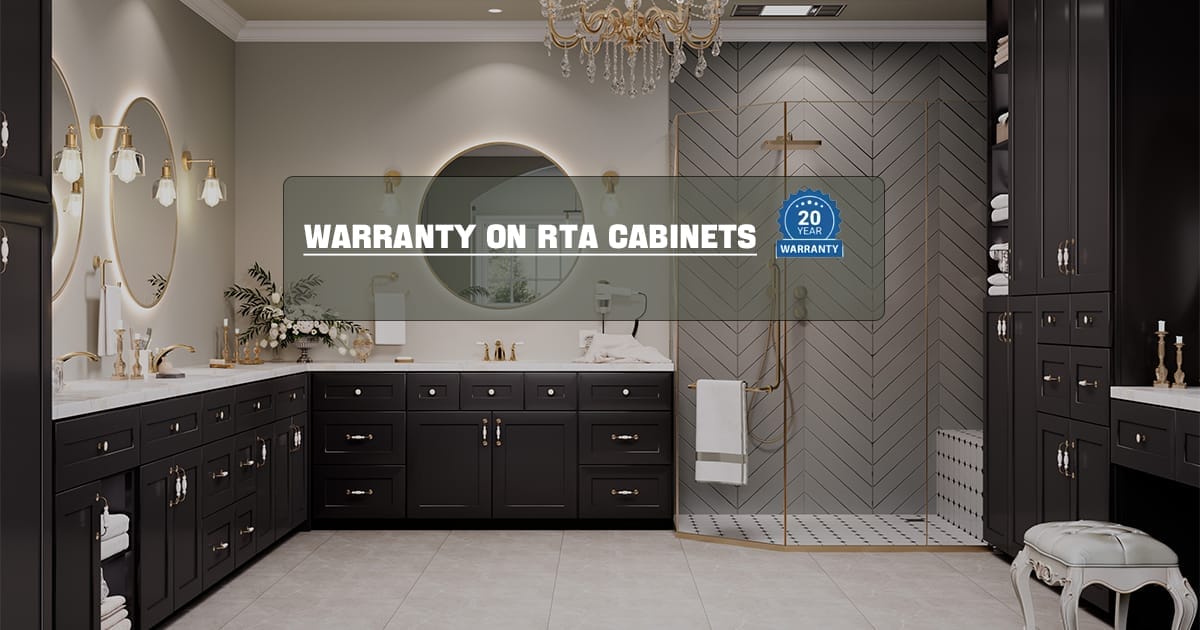
What Is the Warranty on RTA Cabinets?
Your guide to understanding warranty coverage for Ready-To-Assemble kitchen cabinetry
When you’re remodeling a kitchen in the U.S., more and more homeowners are choosing RTA (Ready-To-Assemble) cabinets. The appeal is clear: competitive pricing, faster delivery, and the flexibility of DIY-friendly installation. But alongside the paint swatches, hardware pulls and layout decisions, there’s one critical question: what happens if a cabinet part fails down the line?
You’ve invested time, budget and design energy. You want to know: how long can I rest easy? What happens if that door warps, that hinge loosens or the finish bubbles?
This article is written for three key audiences:
- The household home-manager who simply wants a kitchen that works and lasts without constant repair.
- The capable DIY enthusiast who will install the cabinets himself, and wants to understand warranties, risks and trade-offs.
- The designer or remodeling professional who needs to understand warranty policies, manufacturer commitments and how they tie into specification, installation and client expectations.
Our goal? From a design-professional viewpoint:
(1) to unpack what typical RTA cabinet warranties cover,
(2) to explore how warranty relates to materials, installation quality and style choices, and
(3) to offer practical advice for renovation and new-install situations — with a real-world brand case to illustrate.
Table of Contents
1. Understanding the Key Elements of Cabinet Warranties
In the cabinetry world, a “warranty” (sometimes “limited warranty,” “lifetime warranty,” etc.) is the manufacturer’s or supplier’s commitment that their product won’t fail due to defects in materials or workmanship under normal use.
In the case of kitchen cabinets, warranty coverage often includes:
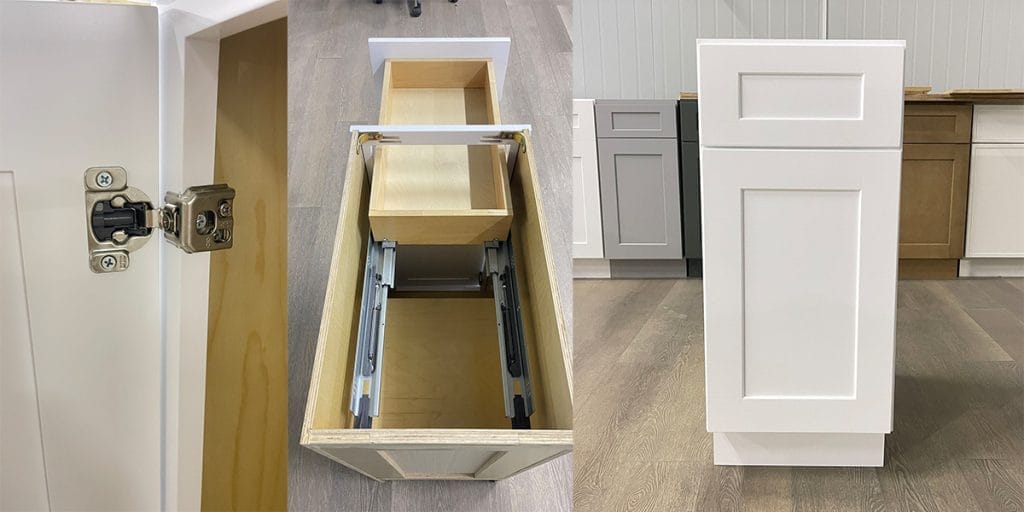
- the cabinet box structure (e.g., joints, assembly, whether the box holds its shape),
- doors or drawer fronts cracking or splitting,
- hinges or drawer slides/rollers failing prematurely,
- finishes peeling, bubbling or delaminating, and
- warping, bowing or structural deformation.
At the same time, typical limitations apply:
- The warranty is valid only for the original purchaser, and often only for residential use.
- If installation was improper (walls out of plumb, improper fasteners, inadequate clearances), or if environmental conditions are abusive (excessive humidity, direct water exposure, misuse) the warranty may be voided.
- “Natural” variations in wood grain/colour, fading from sunlight, or normal wear-and-tear are often excluded from coverage.
For guidance on what defines good cabinet quality and how that ties into warranty expectations, check out our RTA cabinets quality guide.
Why should each audience care?
- For the home-manager: it’s about peace of mind—your kitchen should give you years of service, not cause ongoing anxiety.
- For the DIYer: you’ll want to know if your installation choices (hardware quality, wall prep, alignment) could affect the warranty.
- For the designer/pro: warranty language is a signal of product confidence, quality and risk mitigation—it must be part of your specification conversation.
2. Warranty Practices in the U.S. RTA Cabinet Market
Let’s look at real-world examples to get a feel for what different warranty terms look like:
- One online retailer offers a 5-Year Limited Warranty: if any product fails due to defects in materials or workmanship under normal use within five years, they will repair or replace the defective part at their discretion. RTA Cabinet Store
- Another brand offers a Lifetime Limited Warranty to the original residential purchaser — covering cabinets, hinges and drawer glides, while still excluding labour, installation errors and environmental misuse. RTA Direct
- For example, RaraRTACabinets offers a 20-Year Warranty covering defects in materials and workmanship from date of purchase, for residential use only. You can see how it ranks among other top kitchen cabinet brands in our Top Kitchen Cabinet Brands 2025 guide.
From these examples we draw several observations:
- Warranty durations vary widely: from 5 years, 10 years, 20 years to “lifetime”.
- Longer warranties often correlate with higher-end lines, better materials or higher price.
- A “lifetime” warranty sounds attractive—but you must look carefully at the exceptions, conditions, and what “lifetime” actually covers (often parts only, original purchaser only, excludes labour).
- Even with a longer warranty, conditions such as installation, environment, user behaviour still apply — and these often void the warranty if not honoured.
Brand Spotlight: RaraRTACabinets Warranty
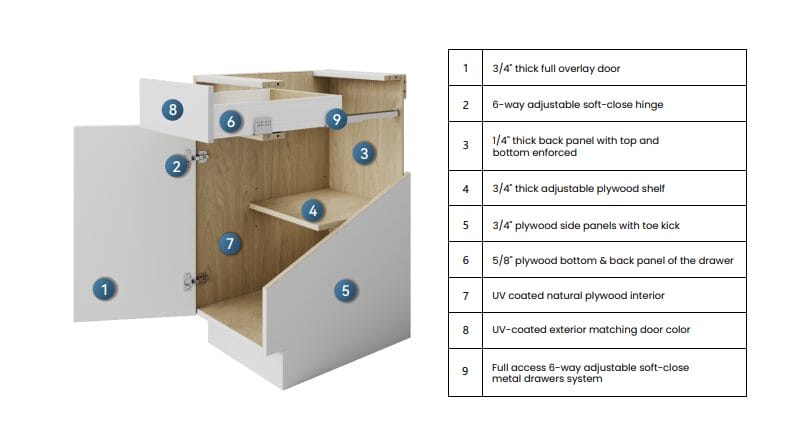
- RaraRTACabinets backs its cabinets with a “20 Years Warranty” for defects in materials and workmanship for residential use by the original purchaser.
- That warranty is limited to repair or replacement of the defective part at the manufacturer’s discretion and explicitly does not include labour for removal or replacement.
- Exclusions include: improper handling, storage, installation, assembly/disassembly, intentional damage, product modifications, exposure to elements including humidity (which may result in warping or splitting), accidental misuse, abuse or negligence.
- It also clearly states that natural changes in wood (variation in texture, colour, grain, joint cracking, darkening/lightening over time) are not considered defects and thus not covered.
- Climate considerations: If the product is installed in extremely humid area or a building without air-conditioning, dimensional changes due to humidity are considered normal and are not covered.
- Warped doors: The policy says doors should go through a full heating/cooling season before replacement is considered, and hinge adjustment may resolve the issue first.
- If a particular style or finish is discontinued, the company reserves the right to replace with a functionally equivalent part or charge parts + shipping if they still source it.
By integrating RaraRTACabinets’ actual policy, we highlight how even strong warranties come with caveats — a crucial lesson for your audience.
3. How Warranty Intersects with Materials, Installation & Style
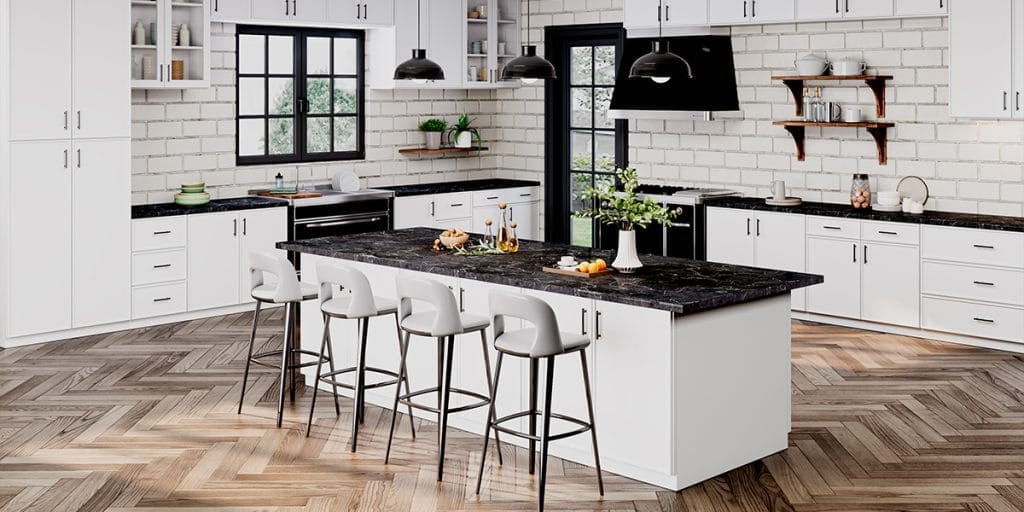
Understanding the interplay between warranty and other factors helps you make smarter choices.
Materials and build quality
If the cabinet box is constructed of high-grade plywood, doors are solid wood or premium veneers, and hardware (hinges, slides) comes from reputable manufacturers, then the risk of failure drops — and manufacturers feel comfortable offering longer or broader warranties.
Conversely, lower-cost materials (particle board core, thin MDF doors, economy hardware) often carry shorter warranties or stricter terms.
You can read more about choosing the right cabinet materials to understand how quality impacts longevity and warranty coverage.
With RaraRTACabinets, for example, their 20-year warranty presumes residential use, proper installation and absence of abusive environmental conditions. If you choose a line with less rigorous build quality, you’ll see shorter warranty durations or more restrictive exclusions.
Installation and environment
Even the finest cabinet won’t perform if poorly installed. Walls must be plumb, cabinets properly secured, levelled and anchored; clearances must meet design specs. Many warranty statements exclude failures caused by “improper installation,” “alteration,” “exposure to extreme moisture/humidity,” etc.
RaraRTACabinets’ policy explicitly mentions improper installation or exposure to elements like high humidity as exclusion criteria.
So, if you DIY, follow instructions meticulously — or consult a cabinet installation guide to ensure high standards. If you work with a professional installer, make sure they adhere to these standards. Failure to do so may negate warranty coverage even if material quality is good.
Style / customization / usage context
If you choose high-end finishes (custom stains, exotic wood species, integrated lighting, large overhangs), or if your usage is non-standard (commercial usage, heavy-duty usage) you may fall outside the typical “residential normal use” that warranties cover. Some warranties exclude custom modifications, non-standard installations or non-residential settings.
RaraRTACabinets states “residential applications only” and reserves the right to deny coverage if the usage veers from that.
From a designer’s viewpoint: When your aesthetic vision demands unusual materials or configurations, insist on seeing the warranty language that applies specifically to that line/usage.
Design-professional tip
While warranty is not the only indicator of quality, it is a strong signal. A longer or more comprehensive warranty suggests: the manufacturer trusts their build; the quality is consistent; they expect customers to keep the product long-term. Use warranty period + exclusions + material/installation requirements as one of your evaluation metrics alongside style, finish, cost and delivery speed.
4. Warranty Advice for Renovation & Remodel Scenarios
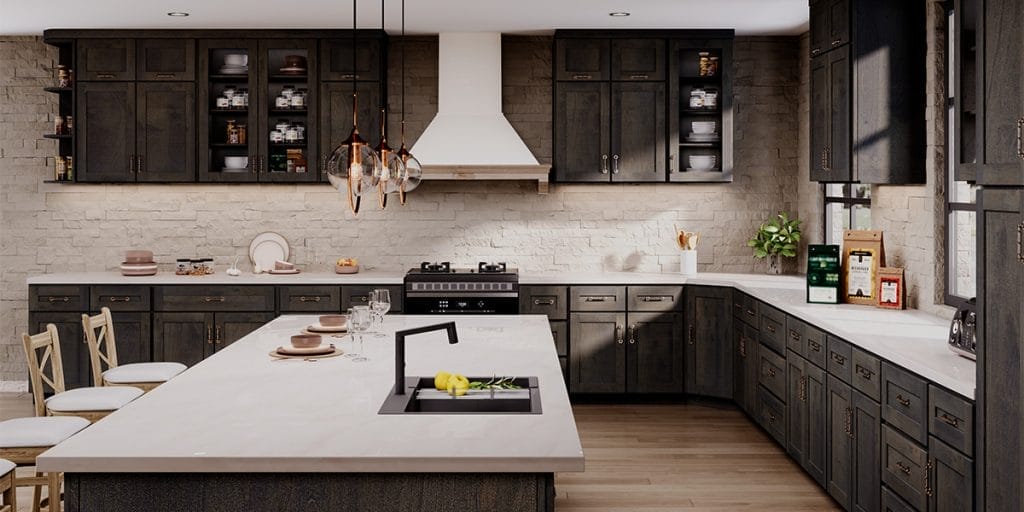
For a full new installation of RTA cabinets
- Budget for a line that offers a longer warranty and has a clear, readable warranty document.
- During your planning/design phase: ask the vendor to clarify which components are covered (box, doors, hardware, finish), who is responsible for labour, whether the warranty is transferable, what you must do to maintain the warranty (e.g., register the product, keep proof of purchase). For detailed guidance on planning an efficient and durable kitchen layout, check out our Kitchen Planning Rules guide.
- As you install: keep photos of the process, retain proof of purchase, record serial numbers if provided, save installation instructions and final inspection documents. These elements will help if you ever submit a claim — following a step-by-step cabinet installation guide ensures you document everything properly and avoid common pitfalls.
For a renovation that retains some existing structure
keeping old box and replacing doors/finish:
- Be sure the existing structure meets the supplier’s requirements for warranty validity. If old boxes are warped, improperly anchored, or out of level, the manufacturer may reject a warranty claim later.
- If you are mixed-install (existing structure + new cabinetry), clarify with the vendor: does the warranty apply fully when part of the system is reused? What parts are excluded?
- For changes/modifications (e.g., cutting into old wall, moving plumbing, adding lighting), ensure the vendor confirms coverage under the warranty.
DIY installation and warranty risk
- Some warranties require professional installation or may invalidate coverage if you alter the cabinet from its original configuration (e.g., trimming boxes, drilling extra holes for wiring, changing hardware from what is approved).
- If you are comfortable with DIY, make sure you follow the manufacturer’s instructions exactly. Save your installation checklist, document your process.
- If you ever modify or adapt the cabinet for non-standard usage (heavy-duty, commercial, outdoor), check with the manufacturer whether the warranty still applies.
Design-professional tip
Think of the warranty as part of your specification and risk-management strategy. A well-designed kitchen is not only about visual harmony and efficient layout—it also delivers reliable performance for years. Ensuring that your cabinetry is backed by a robust warranty is part of delivering value to the homeowner.
5. Designer’s Quick Summary & Action Checklist
Core takeaway: In the RTA cabinet market, warranty policies differ widely—from 5 years, 10 years, 20 years to “lifetime”—but more important than the number of years is what the warranty covers, what it excludes, and what the installation/usage conditions are.
Action checklist for your readers
- Before purchase: Request or review the full written warranty from the manufacturer/vendor.
- Check coverage: Which components are covered (box, doors, hardware, finish)? Which uses/environments are excluded (commercial, outdoor, high humidity)?
- In design phase: Incorporate material quality, installation standards and environment control (humidity, ventilation) into your spec. A superior warranty plus good materials + proper installation = stronger outcome.
- Keep records: Save your purchase receipt, photos of shipped materials, installation photos, serial numbers if any. These support a warranty claim.
- For remodels: Confirm compatibility of old structure with the new warranty. If re-using old boxes, verify that they meet the warranty’s condition, or consider fresh cabinets for stronger coverage.
- Communicate to client (or yourself): Warranty is a signal of quality and confidence. It doesn’t guarantee everything—but a manufacturer willing to stand behind their product says a lot.
Final designer’s word
In my years of specifying and remodeling kitchens, I have seen many instances where the homeowner loved the style, loved the hardware, but underestimated the importance of installation precision or misunderstood the warranty terms—and later faced unexpected repairs, warping or finish problems. A truly good cabinet is one that looks beautiful, functions reliably, and is supported by a clear warranty and installation regime.
When you plan, design, and install with that holistic mindset, you won’t just choose a cabinet that looks great—you’ll choose one that gives peace of mind.
For readers of our site ( https://www.rarartacabinets.com/) — we focus on high-value RTA cabinets, factory-direct pricing, U.S. warehousing and fast shipping. We also emphasise transparent warranty coverage (such as the 20-year coverage at RaraRTACabinets). Use this article as your design-oriented reference: style + structure + support. Your next cabinet install can be not only visually elegant — but also confidently backed.


Related posts

In 2026 the most practical and reliable bathroom color strategy is to use light neutral tones that feel timeless comfortable and easy to live with... Continue reading

A 30‑Year Veteran Designer’s Honest Guide for Homeowners When you’re planning a kitchen remodel, it’s common to overlook just how big a chunk of the... Continue reading

When it comes to the quality of a cabinet, the material is key. On the U.S. market today, cabinets are generally made from five types... Continue reading
Imagine you’ve carefully selected your dream kitchen cabinets. You’re excitedly waiting for delivery, only to find the cabinets don’t fit properly—doors won’t close, drawers slam... Continue reading

Did you know that kitchen cabinets can account for 30% to 40% of a total kitchen remodel cost? That means if you’re working with a... Continue reading










Add comment