No products in the cart.
Return To Shop


Kitchen Cabinet Buying Guide: Materials, Sizes and Costs
Choose kitchen cabinets by checking whether the collection can complete your layout, provide the storage you need, and fit your total project budget. Then compare cabinet construction, door finishes, assembly requirements, delivery terms, and replacement support.
Start with room measurements and appliance specifications before selecting cabinet sizes. A collection that lacks the right sink base, corner unit, or finishing panels may require a different layout, even if you like its doors.
This kitchen cabinet buying guide takes you through those decisions in order, from choosing a cabinet type to reviewing the final order.
What to Look for When Buying Kitchen Cabinets
Before comparing colors and door styles, check the features that affect how your cabinets will perform every day:
- Cabinet construction: Compare plywood, MDF, particleboard, panel thickness, and back-panel construction.
- Hardware quality: Look for durable hinges, full-extension drawer slides, and soft-close hardware in high-use areas.
- Layout and dimensions: Make sure cabinet sizes, appliance clearances, fillers, and walkways work with your actual kitchen.
- Finish durability: Consider moisture resistance, scratch resistance, cleaning, and how the finish will hold up to daily use.
- Storage: Choose drawers, shelves, pantry cabinets, and organizers based on what you actually store and use.
- Total cost: Compare more than cabinet prices. Include fillers, panels, trim, shipping, assembly, and installation.
- Warranty and replacement support: Check what happens if a door, drawer, or cabinet arrives damaged or needs replacement later.
Use these criteria to compare cabinet collections before focusing on colors or advertised discounts. Start with your kitchen measurements, then confirm construction, storage, installation requirements, and the full cost of the cabinet order.
Table of Contents
Choose Between Stock, Semi-Custom, and Custom Cabinets
The first question is whether standard cabinet sizes can complete your kitchen layout. Stock, semi-custom, and custom describe the available sizing and modification options; they do not tell you whether the cabinets arrive assembled.
Stock Cabinets
Stock cabinets come in a defined range of sizes, finishes, and configurations. Check the complete size list before choosing a collection, including corner cabinets, pantry units, fillers, and finished panels. Standard sizes can work well when those components fit the room and appliance requirements.
Semi-Custom Cabinets
Semi-custom cabinets offer selected modifications within a manufacturer’s product system. Ask which changes are available, what they cost, and whether they affect delivery. The term does not mean every dimension or feature can be changed.
Custom Cabinets
Custom cabinetry can address dimensions or configurations outside a standard product range. Compare the proposed materials, construction details, drawings, finish samples, and installation scope before approving an order.
Whichever type you choose, verify the specifications. A sizing category alone does not establish cabinet quality.
Plan Before Buying Kitchen Cabinets
Before choosing cabinet materials or door styles, confirm that your kitchen measurements and layout can accommodate the cabinets you plan to order.
1. Measure the Kitchen and Appliances
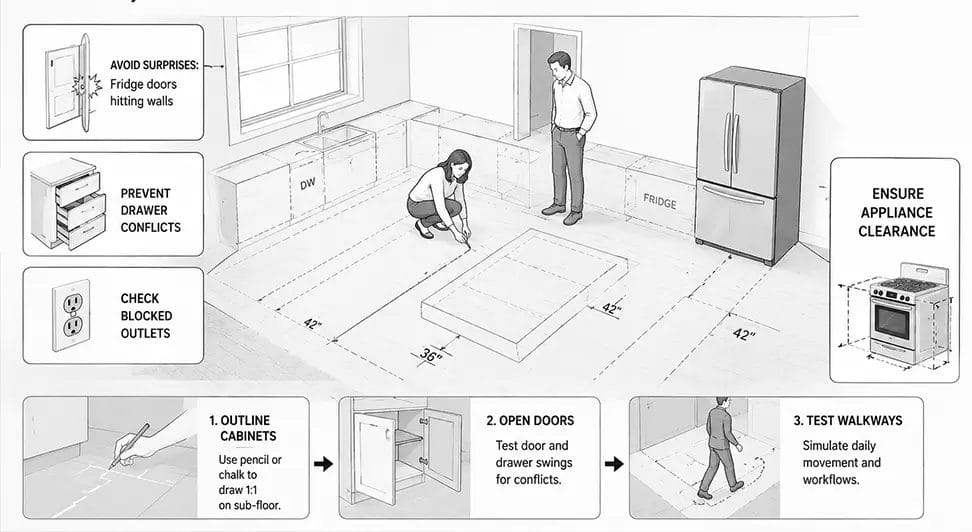
Record the length of each wall, ceiling height, window and doorway locations, and the positions of plumbing, electrical outlets, and ventilation.
Use the actual dimensions of your refrigerator, dishwasher, range, and other appliances. Allow for door swing, drawer extension, fillers, finished panels, and installation tolerances.
A cabinet that fits the available wall length may still cause problems if it prevents an appliance door from opening.
For a detailed measuring process, see our How to Measure Your Kitchen for Cabinets guide.
2. Choose Cabinet Sizes and Storage Configurations
Standard kitchen base cabinets are commonly 34.5 inches high and 24 inches deep before countertops. Wall cabinets are often 12 inches deep, with different widths and heights available by collection.
Use drawer bases for cookware and frequently used items, door-base cabinets for larger storage, and wall cabinets for dishes and supplies. Corner cabinets, sink bases, pantry cabinets, and appliance cabinets should be selected according to the actual layout.
Check that every required cabinet size is available in the collection you want. If a collection lacks a necessary width or corner configuration, changing to another door finish will not solve the layout problem.
See our Kitchen Cabinet Size Chart for common dimensions and planning examples.
3. Set a Cabinet Budget Based on the Complete Order
Build your cabinet budget from an itemized layout rather than an advertised starting price. The quote should identify cabinet quantities, sizes, finishes, and the components needed to complete the installation.
Check whether it includes:
- Base, wall, tall, drawer, and specialty cabinets.
- Fillers, finished end panels, toe kicks, and required trim.
- Hinges, drawer slides, shelves, handles, and selected organizers.
- Freight and any additional delivery services.
- Cabinet-box assembly, installation, and finishing labor.
- Applicable taxes.
For example, two quotes for a 30-inch base cabinet may include different finishing components. If one collection has a matching finished side and another needs a separate end panel, compare the completed configuration and its finished width.
Keep countertops, appliances, plumbing, and electrical work separate unless the quote expressly includes them. Use our kitchen cabinet quote comparison guide to review the scope before comparing totals.
If you are still preparing a budget, use our kitchen cabinet cost estimator for an initial estimate, then confirm the total with an itemized quote for your layout.
4. Decide Which Features Matter Most
Prioritize the cabinet components that will affect daily use:
- Drawer storage for cookware and frequently used items
- Reliable hinges and drawer slides
- Cabinet dimensions compatible with your appliances
- Finishes that suit your cleaning and maintenance needs
- Available replacement parts and clear warranty terms
Decorative trim and specialty accessories can be considered after the core cabinet layout and construction requirements are established.
How to Buy Kitchen Cabinets Online
Before ordering kitchen cabinets online, check that the product information, cabinet list, and delivery arrangements describe the same complete project. A room rendering helps you visualize the kitchen, but it does not replace an itemized order.
1. Match Every Cabinet to the Layout
Check each cabinet’s SKU, quantity, width, height, depth, finish, and configuration against the drawing. Identify sink bases, drawer bases, corner cabinets, and appliance cabinets individually rather than relying on a total cabinet count.
Confirm door handing where applicable. Also check whether the listed dimensions include doors, finished panels, or other projections.
2. Review a Door Sample
Use a sample to judge the finish beside your flooring, countertop, and wall colors. View it in daylight and under the lighting planned for the kitchen.
A sample helps you assess appearance and surface texture. It does not confirm the construction of the cabinet box, drawer system, or every component in the collection.
3. Confirm Availability and Delivery Requirements
Ask whether the complete order is available and whether any components will ship separately. Check delivery access, unloading arrangements, storage space, and the procedure for reporting missing or damaged items.
Coordinate installation around confirmed delivery information, with time to inspect the shipment before work begins.
4. Check the Final Order Before Paying
Review the itemized order against the latest layout. Confirm required fillers, end panels, toe kicks, hardware, and accessories, including anything ordered separately.
Read the written cancellation, return, damage-reporting, and replacement terms. Save the approved drawing, order list, specifications, and relevant correspondence together.
How to Compare Kitchen Cabinet Suppliers
When comparing kitchen cabinet companies, use the same kitchen layout and cabinet list for every quote. Two suppliers may advertise similar cabinet prices but include different hardware, finishing components, shipping terms, or services.
Kitchen Cabinet Supplier Comparison Checklist
| What to Compare | What to Confirm Before Ordering |
|---|---|
| Cabinet Construction | Box materials, panel thickness, back construction, doors, drawers, and hardware |
| Available Sizes | Base, wall, sink, corner, pantry, filler, and finishing options required by your layout |
| Assembly Format | Whether cabinet boxes arrive ready to assemble or already assembled |
| Order Price | Identical cabinet list, quantities, finishes, and accessories |
| Shipping | Freight charges, delivery requirements, lead times, and shipment inspection procedures |
| Warranty | Coverage period, exclusions, replacement procedures, and required documentation |
| Design Support | Whether the supplier can review measurements, cabinet lists, and layout requirements |
Check Whether the Supplier Can Support the Whole Order
Before choosing a supplier, confirm that the selected collection includes every cabinet and finishing component required by your layout. Ask how backorders, missing parts, damaged panels, and future replacement requests are handled.
Compare the written policies as carefully as the product specifications. Check what documentation is required for a claim, which costs are covered, and whether assembling or modifying a cabinet affects return eligibility.
Design support is also useful when it includes a review of cabinet sizes, appliance openings, exposed ends, and required fillers. Confirm what the service covers and which measurements remain your responsibility.
Brand rankings can help you identify companies to research, but the final decision should rest on the selected products, complete order, and supplier terms. For a separate overview of cabinet brands and product lines, see our Best RTA Cabinets Guide.
How to Check Kitchen Cabinet Quality Before Buying
Cabinet quality depends on more than the door finish. Examine the cabinet box, shelves, back panel, doors, drawers, hinges, and drawer slides before comparing prices.
Cabinet Materials and Where They Are Used
| Material | Common Cabinet Applications | What to Check |
|---|---|---|
| Plywood | Cabinet boxes, shelves, and structural panels | Panel thickness, core quality, joints, edge finishing, and moisture protection |
| MDF | Painted panels, certain cabinet boxes, and door components | Material grade, finish durability, sealed edges, and intended application |
| Particleboard | Cabinet boxes, shelves, and furniture panels | Panel density, surface protection, fastening construction, and moisture exposure |
| Solid Wood | Face frames, doors, and decorative parts | Wood species, joinery, finish quality, and allowance for natural wood movement |
No material name alone guarantees a durable cabinet. Compare the actual construction and finish rather than relying only on terms such as premium, all-wood, or furniture grade.
For a more detailed material comparison, read our Kitchen Cabinet Materials Guide.
Drawer Boxes, Hinges and Slides
Check the drawer box material, joint construction, slide type, load requirements, and whether the drawer opens far enough to access stored items.
Dovetail joints and soft-close hardware can be useful features, but they are not substitutes for appropriate materials, accurate manufacturing, and proper installation.
Review the hinges and how they attach to the cabinet. If replacement hardware may be needed later, check whether compatible parts are readily available.
Cabinet Doors and Finishes
Painted wood, painted MDF, thermofoil, laminate, and other finishes have different appearance, maintenance, and repair considerations.
Compare the finish specifications for cleaning requirements, scratches, moisture exposure, and heat sensitivity. Ask for a door sample when color, texture, or finish quality cannot be judged confidently from product photos.
Certifications and Product Documentation
If certifications or low-emission material claims matter to your project, confirm that the specific cabinet product or material meets the stated standard.
Do not assume that a company’s general certification statement automatically applies to every cabinet collection it sells.
Compare Two Similar Cabinets Before Comparing Two Kitchens
Start with one cabinet configuration offered by both suppliers, such as a base cabinet with one drawer and two doors. Match the nominal size and door finish, then compare the specifications behind the fronts.
Check these details side by side:
- Box construction: Identify the side, bottom, shelf, and back materials, their thicknesses, and how the panels connect.
- Drawer storage: Compare usable drawer dimensions, slide extension, and the specified load capacity when published.
- Door hardware: Check hinge adjustability, opening clearance, and whether compatible replacements are available.
- Finished ends: Confirm whether an exposed cabinet side is already finished or needs a separate panel.
- Included components: Identify shelves, hinges, slides, handles, and accessories included in the listed price.
For example, two cabinets with the same outside width can have different usable openings and drawer interiors. A separate finished end panel can also change the completed run width. Those differences may affect your layout even when the product photos look similar.
Once you understand the differences in a matching cabinet, compare the complete kitchen orders using the same method. Do not extend one cabinet’s specifications to an entire collection unless the supplier confirms they apply.
Kitchen Cabinet Moisture Resistance and Maintenance
Kitchen cabinets are exposed to changing humidity, cooking steam, cleaning products, and occasional spills. The areas around sinks and dishwashers deserve particular attention because leaks may remain unnoticed inside or behind cabinet boxes.
What Should You Check?
- Make sure the cabinet finish and exposed edges are suitable for the intended application.
- Check the condition of cutouts and exposed cabinet panels around plumbing.
- Confirm that the sink base provides appropriate clearance for pipes and maintenance access.
- Address leaks promptly rather than allowing water to remain inside a cabinet.
- Follow appliance manufacturers’ ventilation and installation requirements.
Plywood, MDF, particleboard, and solid wood can all be damaged by prolonged water exposure. Some products are designed to perform better in moisture-prone conditions, but no ordinary wood-based kitchen cabinet should be treated as completely waterproof.
A properly installed sink, maintained plumbing, suitable ventilation, and prompt cleanup are important regardless of the cabinet material.
When comparing cabinets, review the manufacturer’s material specifications and care instructions rather than relying on broad claims about waterproof construction.
How to Choose Kitchen Cabinet Doors and Finishes
Cabinet door style affects the kitchen’s appearance, but it should also work with your cleaning preferences, available cabinet construction, and overall layout.
Shaker vs. Flat-Panel Cabinet Doors
Shaker doors have a recessed center panel surrounded by rails and stiles. They work in traditional, transitional, and contemporary kitchens.
Flat-panel or slab doors have a simpler face with fewer decorative details. They are commonly used in modern and minimalist designs.
Neither door style automatically determines cabinet quality. Check the actual door material, finish, construction, and hardware.
If you are considering Shaker doors, explore our Shaker cabinet styles and construction guide to compare traditional, slim, and micro Shaker profiles, door materials, and finish options.
Framed vs. Frameless Cabinets
Framed cabinets have a separate face frame attached to the front of the box. Frameless cabinets use the box panels without an added front frame. This affects the opening, hinge mounting, and compatibility with drawers and organizers.
Keep construction separate from door style: Shaker and slab describe the fronts, while framed and frameless describe the cabinet structure. Both construction types can use full-overlay doors.
Before choosing a collection, compare its clear openings and the space required by your storage accessories. Our framed vs frameless cabinet comparison explains those measurements in more detail.
Choosing Cabinet Colors and Finishes
White and light-colored cabinets can create a brighter appearance, while wood-look finishes and darker colors produce a different visual effect.
In a busy kitchen, review how the finish handles cleaning, fingerprints, scratches, and contact with moisture. A door sample is especially useful when comparing painted finishes, wood grain, and subtle color differences.
For more detailed color comparisons, see our Kitchen Cabinet Colors Guide.
Choose an Assembly Format That Fits Your Project
RTA cabinets arrive as components that require cabinet-box assembly. Pre-assembled cabinets arrive with the boxes already built. Both still need to be positioned, leveled, secured, and adjusted during installation.
Choose the format after confirming three things:
- Assembly: Who will build and inspect the boxes, and is that work included in the labor quote?
- Access: Can the packaged components or assembled cabinets reach the installation area?
- Schedule: Is there enough time and workspace for receiving, inspection, assembly, and installation?
Assembly format does not establish material quality. Compare the actual cabinet specifications and the complete project cost.
For a detailed breakdown of labor, delivery, quality, and potential savings, read our RTA vs pre-assembled cabinet comparison.
Kitchen Cabinet Buying Checklist: Before You Place an Order
Before purchasing kitchen cabinets, review your measurements, product selections, and order details one final time.
1. Confirm the Complete Cabinet Layout
Check the measured wall lengths, appliance openings, cabinet widths, fillers, end panels, and corner clearances. Make sure the cabinet doors and drawers can open as intended.
2. Review the Cabinet Specifications
Confirm the materials used for the cabinet box, doors, shelves, drawers, back panels, hinges, and slides.
3. Check the Cabinet List
Make sure the quote includes every base cabinet, wall cabinet, pantry unit, sink base, finishing component, and accessory required for the layout.
4. Verify Delivery and Assembly Requirements
Confirm inventory availability, expected shipping arrangements, delivery access, and whether cabinet assembly is required.
Review the supplier’s policies for damaged or missing items before ordering.
5. Check the Total Cost and Warranty
Compare the final itemized price, shipping, applicable taxes, assembly, installation arrangements, and warranty coverage.
Do not rely on an advertised discount without reviewing what is actually included.
Kitchen Cabinet Buying Guide FAQ
How Do I Choose Kitchen Cabinets for My Home?
Start with accurate kitchen measurements and appliance locations. Then choose cabinet configurations that fit the layout and provide suitable storage. Compare construction materials, hardware, finishes, assembly options, and complete order costs before making a final decision.
What Should I Look for in Quality Kitchen Cabinets?
Check the cabinet box construction, panel materials, back panel, shelves, drawers, hinges, slides, and finish. Quality depends on how these components are designed and manufactured, not just the door style or a single material specification.
Are RTA Cabinets Worth Buying?
RTA cabinets can be a practical option when you have the ability or installation support to assemble the cabinet boxes. Compare the actual cabinet construction and total delivered cost rather than assuming all RTA products have the same quality or savings.
Is Plywood Better Than MDF for Kitchen Cabinets?
Plywood is often used for cabinet boxes because of its structural characteristics and dimensional stability. MDF is commonly used for painted doors and panels, and some cabinet systems use it in other applications. Compare the material grade, finish, construction, and intended use rather than treating either material as suitable for every component.
What Should I Check Before Ordering Kitchen Cabinets Online?
Verify the product dimensions, construction specifications, cabinet list, finish, order total, shipping requirements, warranty, and replacement procedures. If the available product information is incomplete, contact the supplier before ordering.
Compare Kitchen Cabinets at RARA
RARA offers Ready-to-Assemble Kitchen Cabinets and Pre-Assembled Kitchen Cabinets across different door styles and cabinet configurations.
Browse the available collections to compare cabinet dimensions, construction, finishes, and assembly options.
If you need help planning a complete cabinet layout, you can also request RARA’s Free Room Design Service before finalizing your cabinet list.


About author

Related posts

A microwave base cabinet places a compatible microwave below the countertop, helping free up counter space and integrate the appliance into the kitchen layout. Depending... Continue reading

Wet bar cabinets provide storage and countertop support for a beverage area with a sink and running water. A practical setup usually combines a sink... Continue reading

Shaker cabinets are kitchen cabinets defined by their simple recessed-panel door design. A traditional Shaker door has five main pieces: two vertical stiles, two horizontal... Continue reading
Kitchen cabinets typically cost $4,500 to $15,000 installed for many standard U.S. replacement projects, according to HomeGuide’s published pricing data. Stock and ready-to-assemble (RTA) cabinets... Continue reading

Bathroom color trends in 2026 are moving toward warmer, more natural palettes rather than stark white and cool gray alone. Light neutrals remain the safest... Continue reading





Add comment